
2025-8Book-Review-August| Download PDF
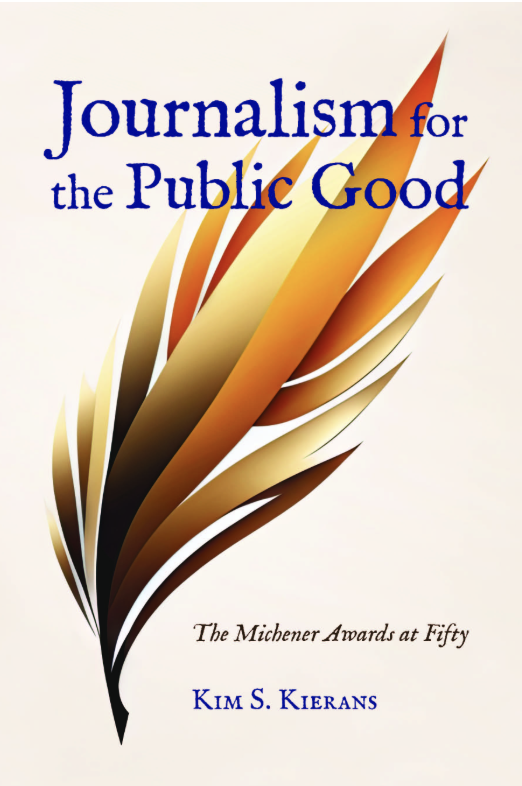
Kierans, Kim. Journalism for the Public Good: The Michener Awards at Fifty. Calgary: University of Calgary Press, 2024, 304 pp., $38.99 (paperback) ISBN 978-1-77385-534-9.
Reviewed by Jeffrey Dvorkin, Massey College, University of Toronto, jeffrey.dvorkin@utoronto.ca
The Michener Awards are the most prestigious recognition of Canadian journalism. This work by Kim S. Kierans is a laudatory history that is appropriately recognized in a study that is well-written, detailed, and long overdue.
Kierans has first-hand experience of the origin of the Micheners (as they are known) from her own work inside the organization as director, board member, and advocate. She has also been a political reporter for the Canadian Broadcasting Corporation. (Full disclosure: our time at the CBC overlapped). This book is the proper acknowledgment of the decades of important journalism done by many hundreds of dedicated and long serving workers in the intellectual trenches of Canadian media.
The Michener Awards are named after a prominent Governor-General of Canada, Roland Michener who saw fit in 1970, to allow his name to be associated with the annual award. In Canada, the Governor General acts as the representative of the British monarch who remains legally the head of state, but not the head of government (that title belongs to the Prime Minister) in Canada.
The Micheners are often compared to the Pulitzer Prizes awarded annually in the United States. Both awards have national significance in each country, and both bestow reputational prominence on the individual journalist and the media organization which employs them. They also have different national profiles in their respective countries and media communities: Pulitzer Prizes, named after Joseph Pulitzer the New York newspaper baron, have a longer lineage going back to 1917. There are 14 Pulitzers administered through the Columbia University School of Journalism. Winning a Pulitzer can be seen as the high point of an American journalistic career. Another important difference: a Pulitzer comes with a $US15,000 cash award. A Michener does not come with a cash prize.
To her credit, Kierans describes how that connection of the Micheners to the Crown is also seen by some in Canada as an impediment to true national recognition of great, if disinterested journalism in the public good. (p. 193).
The appointment of subsequent Governors-General who sometimes came from the ranks of prominent politicians and journalists, allowed for further criticism of the Michener Awards as being unduly partisan and overly governmental. In 1985, Jeanne Sauvé a former CBC/Radio-Canada journalist and Liberal Member of Parliament, was appointed to the office of Governor-General. With the appointment came the administration of the Michener Awards. Sauvé agreed to host the annual awards, but in a change from tradition, there would be no formal gala and dinner as before. (p. 100). Rumours abounded that she was unwell.
Despite the on-again-off-again attitude from official Ottawa, the awards continued, producing some of the most important journalism ever published and broadcast in Canada. Kierans rightly refers to some of the journalism as “not for the timid.” (p. 61). She is right.
The list of investigative reporting deemed worthy by the Michener Awards is long and distinguished. It includes revelations about corrupt politicians, (p.169), environmental disasters (p. 154) and their cover-ups and the shabby treatment by various governments in their neglect of indigenous communities (p. 180), over the years.
Until the early 2000s, the Micheners were overwhelmingly awarded to English-language media, both print and broadcast. Efforts were made to ensure that more French-language media would participate in the award process. The board of the Micheners was broadened to include more French language editors. Governor General Adrienna Clarkson – a former CBC TV host herself – was instrumental in “overcoming the ennui of Quebec media towards the award “, as Kierans correctly notes. (p.148).
Journalism for the Public Good is not shy about pointing out the financial difficulties that media in Canada, and elsewhere, find themselves in. (p. 107). Media organizations in Canada have become tougher (and more bottom-line focussed) when it comes to the requirements of investigative reporting. Older newsroom denizens (and there are still a few) may complain; younger journalists seem more willing to accept the trade-off of more volume for less impact. There are exceptions, thankfully. But many media organizations are forced to focus on the low-hanging (and cheaper) fruit of news content – weather, traffic, and crime.
That over-obligation to shareholders has allowed media convergence in Canada to generate more “news deserts” outside of the hubs of Toronto and Montreal. The rise of the digital culture continues apace with the podcasting culture now further eroding the ability of mainstream media to capture their once large audiences. The economic realities of modern media impinge on the values of the Michener Awards. Yet still the Micheners persist, but for how long? Even well-intentioned governments get tempted to trim budgets that don’t have a large following.
And the very definition of what constitutes the “public good” has evolved since the Michener Awards came into being in the 1970s. Opinion journalism is more valued and given pride of place in the digital landscape in a way that was not permitted a generation ago.
Kierans reminds us that there was once great value in the deep reporting so honoured by the Micheners. Other media awards in Canada, reliant on non-governmental sources of funding challenge the Micheners for national attention. But as Keirans deftly points out, the need for effective contextual reporting has only increased over the years.
Canadians can take pride in the role of the Michener Awards in pointing out the need for bold journalism in a shifting media landscape. Kim Kierans has done Canadians and their media a significant service in producing this important yet hopeful study.
 Journalism History journal