
2025-7| Download PDF
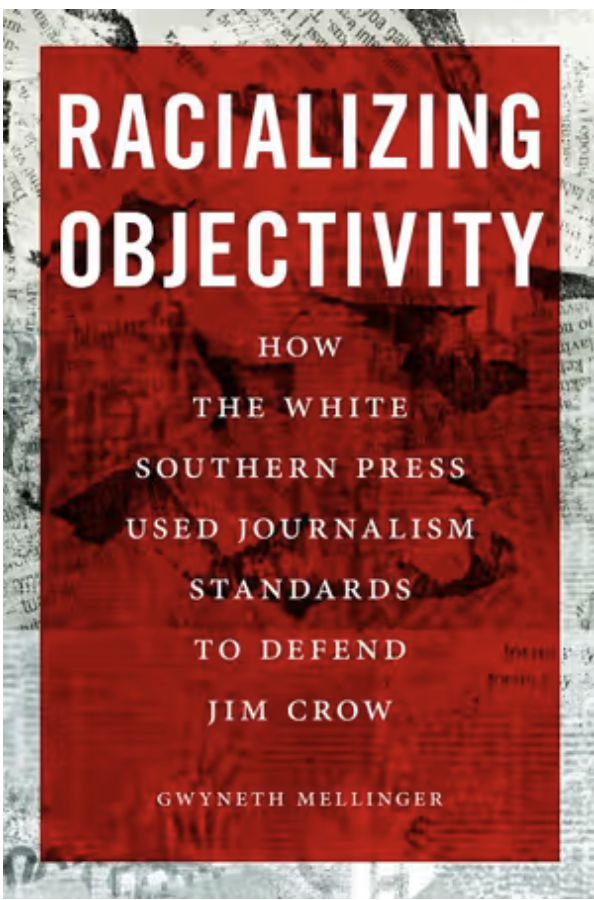
Mellinger, Gwyneth. Racializing Objectivity: How the White Southern Press used Journalism Standards to Defend Jim Crow. Amherst, MA: University of Massachusetts Press, 2024, 288 pp., $32.95 (paperback). ISBN: 9781625348104. Reviewed by Joseph Jones, Reed School of Media and Communications, West Virginia University, (joseph.jones@mail.wvu.edu).
Mellinger’s latest book is a smart and insightful addition to the role of race and white supremacy in the history of American journalism. Utilizing more than a dozen archives and exploring the works of individuals, particular publications, the Associated Press, and trade associations, the author crafts a historical narrative of the highest order, one both engaging and intellectually rigorous. Mellinger clearly demonstrates how certain folks invoked journalism standards to justify racism. While perhaps more ink has been spilled over journalistic “objectivity” than any other concept in our field, this book provides an authoritative and empirically grounded contribution to this debate, one that any serious scholar or even casual observer cannot ignore. Namely, that even as journalists might claim a sense of professional detachment, something like objectivity can be weaponized and used to defend racial and regional identities, and by extension, any element of power differentials or the status quo. In this particular work, such an epistemology is used as a racial strategy, and even the seeming disinterestedness of objectivity is wielded as a political tool. This kind of well-reasoned argument grounded in evidence should cause scholars and newsrooms everywhere to introspect and closely question the specific purposes, practices, and implications of journalism.
What’s more, Mellinger nuances the simplistic narrative of Northern press good-Southern press bad and shows how all of “American journalism was a segregated profession” built on exclusion (p.15). Even as this is a work primarily about the Southern press, the de facto racism of Northern editors is not ignored, and the book offers a broader analysis of American journalism than the title implies. This is especially the case given the thought-provoking afterword (and bonus points for its punny title, “The Birth of a Notion”). Crucially, Mellinger also offers her historical subjects grace, arguing for the sincerity of their beliefs, even if our present standards might find them misguided. In addition to its sophistication, there is a certain maturity and fairness to this work, and one from which many a scholar could learn. I would easily recommend this to a graduate student (or early career professor) as an example of how to build a convincing historical argument fairly and effectively.
The book is organized into five chapters plus an introduction and afterword. While each chapter stands on its own and could be an independently assigned reading, they also hang together to create a coherent narrative around the central argument of racialized objectivity. Chapter one, “Indicting (and othering) the Black press,” shows how white (and some Black) commentators went about the boundary work of defining “legitimate” journalism, not only accusing the BP of not being objective but also denigrating it as inferior, un-American, and unable to make the case for civil rights. Some of these same critics, without irony, would then argue the white press treated Black people kindly anyway, so really there was no need for such an institution. Overall, this chapter shows how objectivity was used against the very voice and viewpoints of Black Americans to dismiss them as unfounded or delegitimate.
Chapter two, “The AP and the Negro identifier,” is a fascinating read about the struggle over racially identifying news subjects. Southern editors (and some readers/journalists across the nation) basically argued that in order to be “objective,” news stories should identity when someone in the story was Black. The same was not required of white news subjects as they were accepted as the norm. This chapter also does an excellent job showing how news values and newsworthiness were different depending on race as well as how news about Black folks was not accepted as “objective” unless it was reaffirming negative racial stereotypes. Chapter three, “The politics of meaning,” focuses on a social critique introduced in the chapter on the Black press, that Black Americans were asking for civil rights too quickly. It details how objectivity was used to support the “gradualist” narrative, essentially the notion that laws were unnecessary and that civil rights should come about slowly and (supposedly) naturally. Effectively, this was an argument for the racial status quo. The chapter (among other things) cleverly uses the various interpretations of a notable speech, one in which a journalist claimed objectivity by employing the notion of criticizing “both sides” (and thus satisfying neither).
Chapter four, “South versus North” highlights the difference in race reporting between the two regions and the rather hypocritical stance of Northern newspapers finding Southern racism newsworthy while minimally covering their own. It also shows how objectivity—far from being impartial—very much depends on what one considers normal, with different journalists having wildly different notions of what such an epistemology implied. The segregationists of the South were also able to weaponize objectivity, using it against entities like the AP and bending the national discourse towards more favorable terms. Chapter five, “Objectivity through a Dixie prism,” analyzes the Southern Education Reporting Service, an organization founded after the Brown v. Board of Education ruling outlawed segregation. It’s stated mission was to provide objective and unbiased information regarding desegregation efforts. Ultimately, this chapter demonstrates how objectivity could be used to control a news narrative and direct it towards specific—in this case racist—preconceived notions.
Overall, this book shows how even if someone truly believes they are being impartial and objective, it is our cultural presuppositions that guide and determine our notions of what’s objective. Because Southern editors believed racial segregation was “normal and necessary” (p. 12) the facts they provided served to reinforce these pre-existing beliefs. In their agenda setting, for example, Southern editors found it necessary and normal to primarily report on Black crime, especially Black-on-white crime that supported segregationist views. Without reporting any other aspects of Black life or providing context for these stories, Southern editors could make the argument that any positive portrayal of Black Americans was biased and misleading. Indeed, one of the hallmarks of claiming objectivity is that “we are objective, they are not.” In the context of colonial studies, Frantz Fanon observed that objectivity is directed against the colonized and argued that such an epistemology only serves to reinforce the colonizer’s power and perspective. Mellinger has shown the same is true of the American context, with Black Americans treated as colonized subjects within their own country. Future research could explore this notion of journalistic objectivity when it comes to Native Americans, immigrants, religious minorities, women, and any host of those considered “others” by dominant presses.
Besides historians, critical-cultural scholars, media sociologists, general journalism studies folks, and especially media ethicists would benefit from reading this book. It is accessible enough for students and lay audiences, while the sophistication of its analysis would best be appreciated by academics. It is a study that lends itself to anyone concerned with the nuances of journalistic truth and media’s central role in constructing our imagined communities.
 Journalism History journal