
2025-5| Download PDF
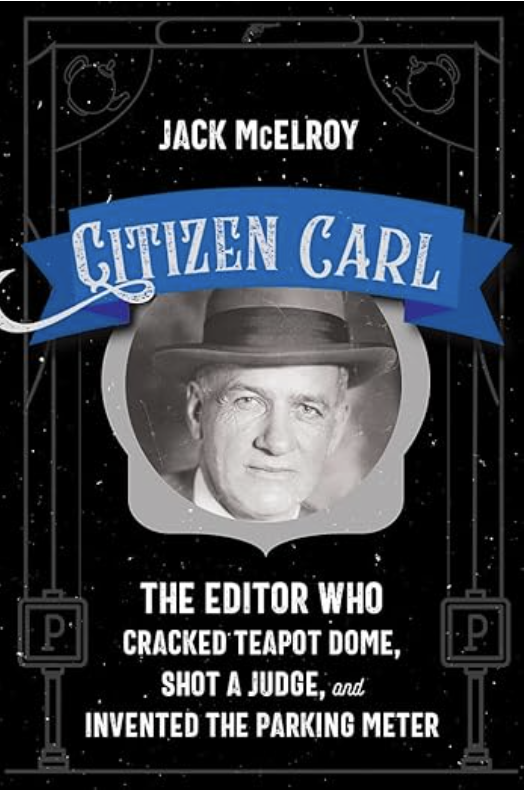
McElroy, Jack. Citizen Carl: The Editor Who Cracked Teapot Dome, Shot a Judge, and Invented the Parking Meter. Albuquerque, NM: University of New Mexico Press, 2024, 296 pp. $24.95 (paperback) ISBN 9780826365767.
Reviewed by Luisa Tilhe, Southern Methodist University, Department of History (lpereira@mail.smu.edu).
The life of Carl Magee was certainly convoluted. As a seemingly relentless newspaper publisher, lawyer, and inventor, his long life was not short of adventure. Jack McElroy, a retired editor himself who spent 14 years at the Albuquerque Tribune – previously Magee’s Independent – was inspired to share the story of an obscure yet important figure in American history, whose motto “Give Light and the People Will Find Their Own Way” is still relevant today.
Although not trained as a historian, McElroy’s work with primary sources was masterful. His effort, combined with the author’s background in journalism, helped him transform a little-known story into a cohesive narrative, an impressive feat considering the magnitude of the story and number of characters involved. In his introduction, McElroy gave the reader a glimpse into the life and legacy of Magee, immediately establishing his importance and place in American history. McElroy even included an Aaron Burr-type mystery with the suspenseful claim that “Whenever attacked, Magee fought back with gusto, too, usually in words, but sometimes with fists, and once with a gun.” (p. 6)
Chapter 1 of the book is a detailed account of Carl Magee’s lineage, tracing his Irish roots to Daniel Magee, who immigrated to Pennsylvania. Although interesting, this chapter is not entirely relevant to the book, especially since McElroy chose to go so far back into Magee’s heritage. While his extended family certainly has interesting characters, perhaps it would have been more compelling for the reader to know about his immediate circle, going back one or two generations at most.
Magee’s early years in the Iowa State Normal School – now Northern Iowa University – and as editor in chief of the Normal Eyte Publishing Company made chapter two one of the best in the book. In it, McElroy took his time in explaining the origins of Magee’s impetus to use the media as a tool to fight for local change. Years later, in 1922, he would continue to fight for change by starting and running his own “truth-telling newspaper.” (p. 55) His goal, as the masthead of Magee’s Independent said, was to “Give Light and the People Will Find Their Own Way”. In the following years, Magee would expose and openly criticize the inner workings of New Mexico politics, and his activism would lead him to uncover the biggest political scandal in American history until Watergate, the Teapot Dome.
While chapters one and two stand out, the rest of the book elaborates on Magee’s personal and professional trajectory as he embarked on different projects directly or indirectly related to public service. McElroy managed to paint a full picture of Magee’s life in all of its complexity, detailing the motivations of someone who, though very significant, might have otherwise gone unnoticed. Therefore, McElroy’s mission to highlight Magee’s relevance is a valiant effort in spreading the word about an unspoken hero of American history. Finally, his writing style and his effort to provide context for the reader ensure that this book is accessible to a wide audience who might be interested in the history of journalism and those who helped transform the profession over time.
Magee’s story, though convoluted, ultimately serves as an example for those who believe in the power of the media and everyday activism. His writing for Magee’s Independent led to a Senate investigation into the finances of Interior Secretary Albert Bacon Fall, which ultimately exposed the wrongdoings of the Warren Harding administration. Consequently, Fall would go on to become the first presidential cabinet in U.S history to go to prison. Magee’s legacy is defined, therefore, by the importance and the many challenges of holding important political figures accountable, an increasingly taxing and aspiring goal a century later.
 Journalism History journal