
2024-10| Download PDF
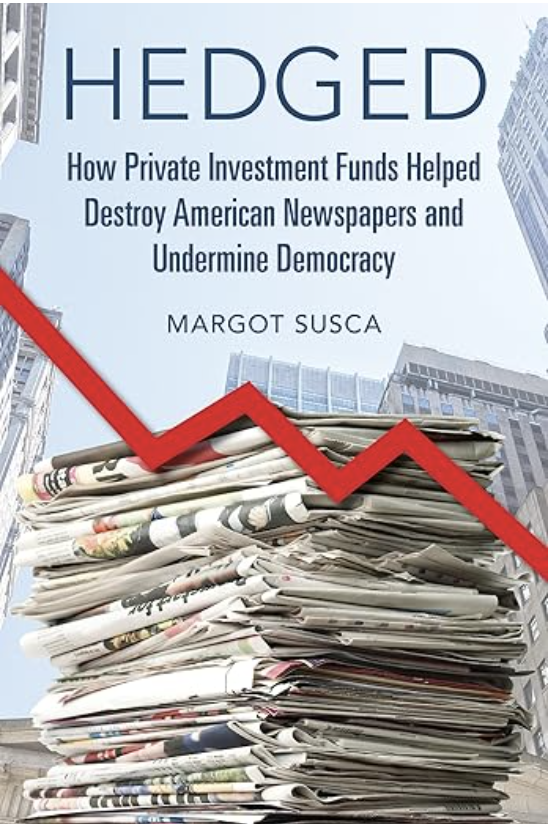
Susca, Margot. Hedged: How Private Investment Funds Helped Destroy American Newspapers and Undermine Democracy. University of Illinois Press,2024, 215 pp., $19.63 (paperback). ISBN: 978-0252087561 Reviewed by Edgar Simpson, Ph.D., director, School of Media and Communication, University of Southern Mississippi.
Margot Susca, an assistant professor and former journalist, brings in her book Hedged a new and enlightening take on the now-tired refrain of dying newspapers and an endangered democracy clinging to the weakened hero of the local press. Susca eschews the handwringing and sentimentalism that tends to spill from those of us misty-eyed for the thrum of the press and the musty aroma of newsprint and marches clear-eyed through the complicated financial history of local journalism.
However true the tropes of dying newspapers are (and they are largely true), Susca argues those who love local journalism need to focus on how we got here and what needs to be done, not to save print, but to rescue the local journalism that sustains self-governance. With impeccable research that included federal Freedom of Information Act requests, more than 100 interviews, and scouring public financial records, Susca builds an elegantly drawn argument that not just capitalism, but hedge funds and private equity firms as particularly virulent and soulless types of money grubbing, significantly advanced the decline of newspapers. She examines a number of funds and their managers, arguing most dug for gold in the ruin and applied all their economic alchemy to squeezing the last drips of profit from newspapers. “What we have,” Susca writes, “is a crisis of greed.” (pg. 9).
Susca’s clean and accessible prose builds on well-known modern critics of corporate media ownership, such as Robert McChesney. He and others have long argued that the profits needed to please stockholders through quarterly financial reports worked against the core mission of a newspaper to serve its community through accountability journalism.
She begins by making the connection between the corporations who owned most of America’s newspapers at the new millennium and the increasing influence of private equity firms and/or hedge funds. Hedge funds is an umbrella term that refers to pooled investment money specifically designed to return higher-than-average capital gains. She notes, for instance, that Tribune Publishing was making a profit and had $250 million in cash when hedge fund Alden Global Capital took control of the company in 2021. Though still run day-to-day by professional news workers, financial oversight of the newspapers largely fell to distant money managers whose primary job was to enhance short-term profit margins.
Newspapers in the 1990s and early 2000s were particularly attractive targets for Wall Street. Decades of consolidation had led to near-monopolies in some markets, with local and regional newspapers routinely reporting profit margins north of 20 percent, some considerably higher. The fatted calf targets led to a period of merger and acquisitions, with companies snapping up family-run newspapers and smaller chains. While boosting short-term profits, these acquisitions almost always came with large debts.
Hedge fund managers who took over the chains repackaged the debt and sought to reduce costs by slashing news and production staffs. In 2019 alone, Susca notes, Gatehouse cut 200 jobs immediately prior to its merger with Gannett and slashed another 215 soon after. This national trend left local journalism highly vulnerable to nascent digital competitors such as Craigslist, which gobbled up classified advertising, a key source of irreplaceable revenue for local newspapers. The reduced staffs, often hampered by tradition-bound news leaders beholden to far-away overlords, struggled to transition to a consumer market taken over by digital platforms.
As local newspaper staffs declined, so did the journalism that held local officials, organizations, and businesses to account. A growing stream of scholarship is attempting to show rising instances of corruption and malfeasance as a result of absent watchdogs. One study, for instance, points to the positive impact of a single public interest reporter in North Carolina (pg. 110).
The most important strategy in saving local journalism and nourishing an information-starved democracy is to de-couple profit from the work. Non-profit news organizations have risen across the country, seeking to help fill in the gaps left by hedged newspaper operations. Yet, these organizations are only part of the answer. Susca, interestingly, argues that the same forces that helped destroy local journalism could be enormously helpful in saving it. She suggests investment firms like Blackrock, which own pieces of the largest remaining media companies in the country, could use their political influence to push passage of the federal Local Journalism Sustainability Act. Some estimate Congressional action could revive 50,000 news jobs through tax credits and other incentives. Guardrails, however, would have to be put up to ensure the money is used for its intended purpose of informing an increasingly distracted public, rather than lining investor pockets.
Overall, Susca has crafted a well-written book that would serve students of media economics well, but also students of journalism history and all those seeking to explore what comes next for local news. Books like Susca’s are important for anyone seeking to understand how we got where are, the intrinsic dangers to the republic of a weakened reporting corps, and the ongoing efforts to keep public information before the public.
 Journalism History journal