
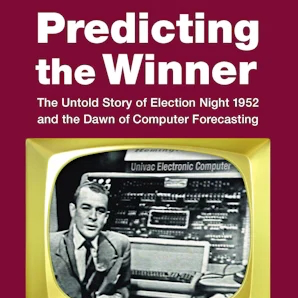
 For the 145th episode of the Journalism History podcast, Author Ira Chinoy discusses his latest book, Predicting the Winner, and the beginning of computer forecasting with elections.
Ira Chinoy recently retired from the University of Maryland Philip Merrill College of Journalism as associate professor of journalism. As director of computer-assisted reporting at The Washington Post, Chinoy was part of a team that won the Pulitzer Prize for Public Service for a 1998 series on the use of deadly force by the D.C. police. Chinoy also shared a Pulitzer Prize in Investigative Journalism with his team at The Providence Journal, where he was a reporter from 1981-95, for coverage of corruption and patronage in the Rhode Island courts. A lauded journalism historian, his latest book is Predicting the Winner: The Untold Story of Election Night 1952 and the Dawn of Computer Forecasting.
Transcript
Ira Chinoy: This was a huge gamble for everybody involved. The computer industry was brand new, and if they messed this up, it would set their little industry back quite a bit. And if TV news messed it up, they would just be subject to more and more ridicule.
Teri Finneman: Welcome to Journalism History, a podcast that rips out the pages of your history books to reexamine the stories you thought you knew and the ones you were never told.
I’m Teri Finneman, and I research media coverage of women in politics.
Nick Hirshon: And I’m Nick Hirshon, and I research the history of New York sports.
Ken Ward: And I’m Ken Ward, and I research the journalism history of the Great Plains and Rocky Mountains.
Teri Finneman: And together, we are professional media historians guiding you through our own drafts of history. Transcripts of the show are available at journalism-history.org/podcast. This episode is sponsored by Lehigh University’s Department of Journalism and Communication, inspiring the future makers.
(01:02): For the first time since 1928, neither a sitting president or a vice president was in the running for The White House. But 1952 was also unusual in other ways for journalists. Coming off embarrassing coverage of the 1948 election, this was, as today’s guest has said, a critical pivot point in American politics, journalism, and culture. It was the first election night with Walter Cronkite on TV, and it was also the first election with computers.
Author Ira Chinoy joins us today to discuss his new book, Predicting the Winner: The Untold Story of Election Night 1952 and the Dawn of Computer Forecasting.
Ira, welcome to the show. Why were you interested in analyzing the election of 1952? What drew you to it in the first place?
Ira Chinoy (01:56): Well, I had been a journalist for 25 years before I came to the University of Maryland, and I was sort of one of the early people in computer-assisted reporting, so-called data journalism now. And so I had a… I needed a dissertation topic when I came. I was both a faculty member and in the PhD program, and I became interested in how computers and journalism first hooked up. And it turned out there was sort of this standard, almost cartoon-like story of, you know, CBS using a big UNIVAC computer on election night. And it was this kind of, you know, man bites dog story. The machine made a monkey out of men – it got it right. People didn’t believe it.
But after that, the UNIVAC was a, you know, computer was a household word. And it was very thin. It was very poorly sourced. And I did some checking of contemporary news accounts, and I started seeing reference to a second computer. And I was really blown away by that because it wasn’t in any of the accounts I had seen, a very small computer, the size of a desk called the Monrobot. And so, I tracked down the company and the CEO. And he was not familiar with this. He had come in the 1970s. But when I asked him if there were any records from the ’50s, he said he had been waiting years for someone to answer that, ask him that question.
(03:12) And he had been saving records. And he, you know, he said I could come up and see him. And he had cabinets and cabinets and cabinets of old records. And one of them had this company’s magazine, a very glossy, in-house magazine from the 1950s. And there from November 1952 was this double spread that had all this stuff about how this little computer had been used. So I was – I was hooked. And, and, you know, everything just sort of tumbled out from that.
Teri Finneman: Before we delve further into 1952, let’s provide some more historical context. Until 1848, there wasn’t a single national election night. You talk quite a bit about what election nights used to be like, but give us a brief overview and some of the technology involved.
Ira Chinoy (04:03): Yeah, that wasn’t originally what I was going to research, and I came to it in a roundabout way. My daughter went to high school nearby, and every year they had this used book sale. And there was a book on the American presidency, and it had a page with a campaign poster for Woodrow Wilson in 1916 and in St. Louis. But what caught my eye was there was a poster right next to it for a burlesque house. And it advertised two big shows with Parisian flirts. And at the bottom, it reassured patrons that if they came on election night, they wouldn’t miss out. That this theater was gonna have election returns by special wire. And it just raised this whole set of questions for me about what election nights had been like before.
And then when I sort of opened up, you know, sort of opened up that, that world to explore it, it turned out there have been all kinds of technologies and approaches and tools. There was a device called a stereopticon, otherwise known as a magic lantern, that newspapers in the latter part of the 1800s would shine, you know, basically like transparencies up on the side of a building and show returns. And there were search lights that were used with codes that we published ahead of time where readers of the paper could save these. And they would know that if the light, you know, was shining in one direction, so and so had won and another direction, somebody else had won.
(05:26) One newspaper borrowed a steamship whistle and powered it with this powerful steam plant in a local building and also there were codes for that. Another paper had built special kites that would fly strings of lights that were basically coded, multicolor coded. And then there are things that we, you know, we sort of get in our history, the early experiments with wireless. You know, election night was used as a place to roll out these new types of news, news over the air. And there’s a really famous … There was this famous sort of technology, I guess you would call it, that ran around the New York Times building. It was called the zipper, and it was news in lights. And the Times chose an election night to – chose an election night to roll that out in 1928.
(06:23) So it turned out there were just lots of things over time. And of course, when radio did come along, the radio broadcasters had, you know, they didn’t know how to do this. And so they had to figure out how to do an election night and hold an audience.
Teri Finneman: Jumping ahead to 1948, remind us what happened that year that made it important to have a good election night performance in 1952.
Ira Chinoy: Well, in 1948, it’s famous for the fact that the journalists got it wrong on election night. Uh, one of the Chicago papers very famously published a headline that the candidate Thomas Dewey had defeated the incumbent [Harry] Truman. And Truman made fun of journalists over that. And TV journalists had done the same thing, in part because, you know, as humans what we see is colored by what we expect to see. And everybody expected Truman to lose. And so that’s how journalists of that day kinda read the returns. And they didn’t wait long enough to declare the, you know, declare it over.
(07:33) And then in addition, Jack Gould, who was the TV critic for the New York Times, itself a brand new… This is a brand new occupation, TV critic. And he really criticized the TV news people for a very lackluster presentation of returns on election night in 1948. So there was this – this crisis basically that was of credibility, you know, facing journalists, TV journalists in 1952, which was they needed to prove that their baby, this new medium for news, was really a good visual medium. And they had to get it right. And so that, that really set the stage for this experimentation with computers in 1952.
Teri Finneman: Yeah, let’s continue talking about that. So how did the TV networks even get into the idea of using computers in election coverage?
Ira Chinoy (08:25): So, it came about in a sense by accident. There are various accounts. But in, you know, at some point in the run-up to the election some months ahead of time, someone from CBS reached out to Remington Rand. And Remington Rand was a manufacturer of a variety of kinds of equipment. Um, and one of them was this computing. But they also, you know, they had other kinds of office equipment. And CBS reached out to them not knowing about the computers, and they asked if they could borrow some, you know, typewriters, adding machines, that sort of thing.
And the Remington Rand rep said, “Well, why don’t you use our new electronic brain?” Which is what computers were called in the day. And at Remington Rand one of the inventors of this UNIVAC, this large eight-and-a-half ton computer, had been wondering whether there could be a place for computers on election night. So that came together in that way.
(09:21) And then at NBC, we don’t really quite know how it – how it came to pass. But somebody who was involved in the development of the computer at the Monroe Calculating Machine Company seemed to know Robert Sarnoff – David Sarnoff, I’m sorry, the head of RCA, and so, you know, which was the parent company of NBC. So that’s seems to be how that connection came about
And you have to understand that this was – this was a huge gamble for everybody involved. The computer industry was brand new. And if they messed this up, it would set their little industry back quite a bit. And if TV, TV news messed it up, they would just be subject to more and more ridicule. So it was a, you know, it was a gamble. Um, but they … in the end, neither network relied on the computer solely. They had lots of other ways of knowing on election night and sort of hedged their bets.
Teri Finneman (10:22): Both NBC and CBS decided to experiment with computers in 1952. Why didn’t ABC?
Ira Chinoy: Well, the other big company that was on the verge of launching a new computer was IBM, but it wasn’t ready yet. And ABC did use… They had in the studio some older – some sort of older type of IBM equipment that was for aggregating and calculating, but it wasn’t a computer with the kinda stored program and, you know, that we come to think of as computers. And the head of it, ABC News, someone named John Madigan, was basically dismissive of the idea of using this technology and said that ABC was gonna be relying on human brains including Walter Winchell and Drew Pearson.
Teri Finneman (11:14): This is an era of major journalists like Walter Cronkite and Eric Sevareid. What did they think of having computers integrated into election night coverage?
Ira Chinoy (11:23): Well, Cronkite, who became famous over time as an election night anchor, was – this was his first election night. He was a young man. He’d been a, you know, World War II correspondent for wire service. He worked in radio. He had been recruited to be, you know, to anchor this for CBS on election night. And he was somewhat ambivalent about whether the computers would really add anything.
And Eric Sevareid had also been this well-known World War II correspondent and was especially well-known for his radio broadcasts, eventually for TV. And he was on with Cronkite on election night in 1952. And there was one point at which the UNIVAC computer, you know, the forecasts that went on air were really problematic in various ways. And Sevareid was gleeful about that and said he was glad that what he described [as] their machine competitor was wrong for a while. Uh, and he said otherwise we would all be victims of technological unemployment.
(12:29) And he wasn’t really worried about technological unemployment. I mean, he was – this a character with a lot of gravitas and gave a really great analysis of the election returns. But it kinda shows this attitude at the time of a lot of journalists that this was an imposition in the world of journalism. It was just not… This was not a done deal about whether computers had any place in journalism. And just before the election, Business Week magazine ran a piece about these, you know, robot brains and raised a question about whether computers had any real place in what they called the election night hurly-burly at broadcast studios.
So we make a mistake if we look back and think that everybody would have thought oh, naturally, once computers came along that there would be a place for them in journalism and on election night. But nothing could be farther from the truth.
Teri Finneman (13:23): How did the networks explain this experiment to its viewers?
Ira Chinoy: Well, they did the best they could. Uh, you know, people did not have computers at home. They didn’t have computers at work. So, this was just a brand new world for them. Most people had never even seen one in any form. So, on CBS, Charles Collingwood, another one of these well-known CBS correspondents from the World War II days, was assigned to shepherd this UNIVAC on election night. And even though the computer itself was a hundred miles away in Philadelphia, it was too big to move. They stationed another console from one of these computers on the set. It looked sort of like an organ console. And it didn’t – it wasn’t really doing anything. That it was just there as a prop. But it did have blinking lights. It was said to have been hooked up to something like a Christmas tree light circuit just to make the lights blink.
(14:18) But he was not, you know, he wasn’t selling this as magic. He described it as, and it’s not a joke. It’s not a trick. It’s an experiment. Um, and he explained that the computer wasn’t doing anything differently than what a journalist had done in the past on election night, which was to compare early returns coming in from particular areas to the same places where they had results from previous elections and look at the, you know, what was happening. Was there a divergence from the past or was it similar? But that these computers could do a – crunch a whole lot more data and a whole lot more quickly than humans could. So that’s how he explained it.
Um, you know, there was a torn – it was just sort of really torn between this, you know, gee whiz image of computers with the blinking lights but also trying not to make it be – not to make it seem like magic and sorta convince the audience that actually it’s something that had a lot of familiarity to it.
(15:23) We don’t know a ton about the NBC piece of this in terms of, you know, what was going on behind the scenes. But Morgan Beatty, another well-known NBC correspondent, was assigned to shepherd that Monrobot on air on election night. And there was a young woman named Marilyn Mason who was working on the computer there on the set. And he tried to say that, basically, incoming data is run through the tubes, the circuits, whatever it is, and comparing it to elections from the past. They’re really not trying to make it sound like magic.
Teri Finneman: Through a lot of work, you managed to track down CBS’s election night coverage in 1952. It did not go well for the computer on the air. Tell us what happened.
Ira Chinoy (16:14): Well, the computer was supposed to come on fairly early in that broadcast. The broadcast started at 8:00. Somewhere around 8:30 or so, it was supposed to come on with a projection. Behind the scenes, the UNIVAC team, the mathematicians, the engineers computer people, you know, were assembling data that was being sent to them by CBS. It was being entered in triplicate so there wouldn’t be any errors in the data. And it eventually spit out a forecast and that probably… It’s hard to say exactly when it was. It was before 10 PM, maybe somewhere 9:15, 9:30, somewhere in there. And when these computer – the computer team looked at it, they panicked. They had a kind of a heart attack because it predicted Eisenhower to win by a landslide and which he eventually did win by a landslide.
(17:06): But what happened in 1952 was that the pollsters had ended up predicting a very close election because they didn’t wanna be slammed like they had in 1948. So they were kinda themselves noncommittal. So instead of sort of reading the tea leaves as Eisenhower’s really gonna win this thing, they were much more ambivalent. And so when this computer spit out a landslide, the computer team, they were just, “Uh, what are we gonna do with this? We can’t release this. If we release this and it’s wrong, then we are also just gonna have egg on our face. And no one’s gonna believe these computers. And we really need people to believe computers.”
So they, you know, kinda messed around with the algorithm. And it eventually spit out a projection that was closer. And they fiddled with it all the night. And then finally at end of the night, they did have a projection of a landslide. But what it really tells us is that the computer team there … they had prepared for almost every eventuality. They had another computer standing by. They had, you know, all these ways, you know, entered stuff in triplicate. All these ways of, you know, being able to recover if there was an error, but they hadn’t prepared for the computer… What would they do if the computer spit out a prediction that turned out to be accurate, but at the time nobody believed it? They didn’t have a plan for that.
(18:29) And CBS only had a camera in Philadelphia. They didn’t have a correspondent there. They didn’t have a reporter there. And they didn’t have this two-way conversation where if they had sent some information back to CBS saying, “You know, we’re seeing this kind of funny thing,” the CBS people might have said, “You know, we’re kinda seeing the same thing on the ground, too. Let’s go with your prediction.” So, you know, at the end of the evening, the person in charge of the UNIVAC team had to go on air and sort of tell a story about how they just didn’t believe what the computer had done. And that became this man bites dog, you know, version of the story that carried forward.
But there were lots of other ways of knowing what was happening that night. And reporters in the field, you know, were sort of seeing these divergences from the past. But they missed a chance to sort of be out front. And we don’t really know at NBC why they didn’t put their first broadcast of, of, you know, predictions up until a little bit after 10 PM. We just don’t know why they did that. They claimed that they had much earlier results. But, but we don’t exactly know why.
Teri Finneman (19:37): Now, there are all these fancy touch-screen graphics used by networks on election night. But a famous moment came in 2000 when Tim Russert of NBC used a simple marker and whiteboard during the controversial election night and kept chiding Tom Brokaw to forget all the high-tech computers, take out your slate and your pen, and it’s the good old days are back. There’s also a reference to man versus monsters in your book, which seems to echo the current debate about the use of AI in journalism. With your historical context in mind, what is the balance of technology versus journalists do you think?
Ira Chinoy (20:18): Well, I think that, you know, technology is what we make of it. It’s not a force that stands outside of history as, as a thing unto itself. It is whatever, however we use it. Uh, we can use it to enhance the mission of journalism, but we can’t have blind faith in that either. Uh, you know, history – history tells us that. And the history of computing does show us that there is, you know, there was a lot of ambivalence, of pushback against the idea of using computers. And we’re seeing that now. And it’s not necessarily unwarranted. But AI is gonna be a tool, and journalists are gonna use it.
And where I’m at the University of Maryland, the faculty has a committee of five or six people, really smart people in the College of Journalism, who are deeply exploring how we can get ahead of using AI. So the trick is not to run away from it. The trick is to figure out how to use it responsibly. And I know from my own experience that, you know, just asking ChatGPT, for example, questions about this event that I know a lot about, initially it gives me wrong answers, right. And so we have to be really careful about how we use it.
(21:35) If you ask ChatGPT what does it take to be a good journalist, there’s an excellent set of responses to that. But when you ask it sometimes very specific questions, it spits out with great confidence, it can spit out with great confidence answers that are wrong. And so if we need – what we need really in the future is to convince the public that we are trustworthy and reliable, we may be able to use this to get some really terrific stories, but we better be careful.
Teri Finneman: With another election upon us, so what else do you want people to take away from your book to apply to the present? You note four lessons from 1952 could be applied in making election night a showcase for enhancing trust in journalism.
Ira Chinoy (22:20): Right. Well, you know, initially, this was gonna be a book about innovation in journalism, how innovation, you know, innovations arise, take hold, spread, have resistance. And that’s really what the book was gonna be about. And then after 2020, ’cause I worked on for, off and on for a long time, I realized I needed a different kind of chapter at the end. Uh, sort of a thought experiment about what we can – how we can go forward from the chaos on and after election night 2020.
And so I did, you know, what I saw from 1952 was these four things. The importance of thinking outside the box of conventional journalism. The importance of looking to other disciplines for novel approaches that we might use. Understanding the value of collaborating in previously unimaginable ways, and understand the importance of transparency in explaining new approaches to audiences. And these were all features of election night 1952 when there was a response to the crisis that had been created in 1948. And I think we need to think about those things now. And so in the final chapter of the book, I do, as I said, have this thing I call a thought experiment about how these things might play out, what, you know, what could be done.
Teri Finneman (23:39): And then our final question of the show is, why does journalism history matter?
Ira Chinoy: I think we have to have – we have to understand the historical importance of journalism as a bulwark against enemies of democracy. We’re in that moment right now. And, you know, that played out as pushback against the Alien and Sedition Acts more than 200 hundred years ago and right up now to this sort of evergreen fight against powerful political figures who are trying to erode democracy for their own gain or to preserve their own power. And we see this over and over, and so I think history should be an inspiration to us now about how journalism can play this really important role in preserving and defending democracy as it – it has at key points in the past.
(24:28) And I also think it’s important to understand that journalism has been continually reinvented in the United States and North America, but that the core values, especially a devotion to accuracy have persisted through that change. And I think if we look at journalism history, we can draw that from it.
Teri Finneman: All right. Well, thanks so much for joining us today.
Ira Chinoy: Thank you.
Teri Finneman: Thanks for tuning in and be sure to subscribe to our podcast. You can also follow us on Twitter, @JHistoryJournal. Until next time, I’m your host Teri Finneman signing off with the words of Edward R. Murrow, “Good night and good luck.”
 Journalism History journal