
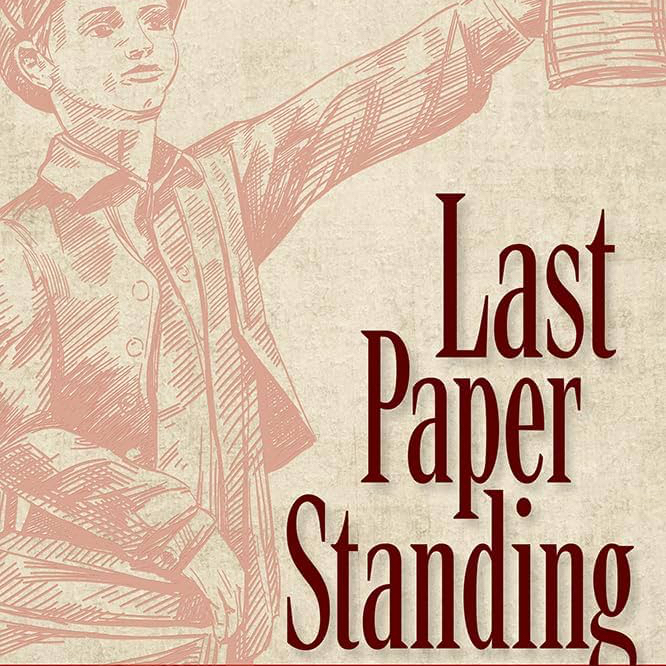
 For the 143rd episode of the Journalism History podcast, Author Ken Ward discusses his new book, which examines a century of competition between the Denver Post and the Rocky Mountain News.
Ken Ward is Assistant Professor of Journalism at Pittsburg State University. His research focuses on the journalism history of the Great Plains and Rocky Mountains.
Transcript
Ken Ward: The fight over circulation was vigorous. And I also think that’s an important part of newspaper history that we often neglect because we’re all so interested in the editorial side of things, how they’re competing over news and over story. But so much of it is on the business end.
Teri Finneman: Welcome to Journalism History, a podcast that rips out the pages of your history books to reexamine the stories you thought you knew and the ones you were never told. I’m Teri Finneman, and I research media coverage of women in politics.
Nick Hirshon: And I’m Nick Hirshon, and I research the history of New York sports.
Ken Ward: And I’m Ken Ward, and I research the journalism history of the Great Plains and Rocky Mountains.
Teri Finneman: And together, we are professional media historians guiding you through our own drafts of history. Transcripts of the show are available at journalism-history.org/podcast.
And now a quick word from our sponsor.
Jason Lee Guthrie (00:59): Hi, Journalism History fans. This is Jason Lee Guthrie, host of the Recollecting Carter podcast. I wanna invite you to join me and guests like Amber Roessner, AJ Bauer and Janice Hume as we explore the life and legacy of America’s 39th president, Jimmy Carter. Find the show wherever you listen to podcasts and at recollectingcarter.com.
[Also thanks to our sponsor Lehigh University’s Department of Journalism and Communication, inspiring the future-makers.]
Teri Finneman (01:25): And now we’re back to the show.
So much of journalism history is focused on the reporting side. Nellie Bly, Woodward and Bernstein, the Pentagon Papers. But as we’re seeing in journalism today, the business side needs much more attention. Today’s guest is a familiar voice to you, Ken Ward, a host of the show.
His book, Last Paper Standing: A Century of Competition Between the Denver Post and the Rocky Mountain News, recently won the History Division’s Book of the Year award. You can also learn more about Ken’s work in Episode 32 of this podcast.
Well, Ken, it sounds funny to say this, but welcome to the show.
Ken Ward: (laughs) Well, thank you very much. It’s great to be here. (laughing)
Teri Finneman: Congratulations on your big win.
Ken Ward (02:15): Yeah. Thank you. It’s a tremendous honor. The book, you know, I’ve been working on this for a long time, and I’m glad that people are finding it useful. It’s fantastic. It’s such an honor.
Teri Finneman: Yeah. So, you know, to actually start this episode, we’re gonna start with the end of your book. You write that Denver journalism is a shell of what it once was. Throughout the book, you trace the long history of two of the city’s newspapers, the Denver Post and the Rocky Mountain News. Only the Post still operates today. What were you hoping to achieve with writing the book?
Ken Ward: Uh, well, it was … I mean, it all started for entirely selfish reasons. As a kid, I grew up with the Denver Post. It was the paper that we had in our house. Now, we lived out in the sticks. We were, you know, an hour and a half outside of any of the cities. But I – we had this newspaper sitting around all the time, and I was fascinated by it.
(03:10) And, and I knew that there was another one, that it looked an awful lot different, and I was fascinated by that one, too. And, you know, as I grew as a researcher and learned more about the way this market worked and everything going on in there, I learned about the Rocky Mountain News.
I just wanted to know what had happened that had led to this, this market having two newspapers for as long as it did, and then ceasing to, right? Because both of those two things are very interesting to me. First of all, you had a two-newspaper town in Denver, Colorado, into the aughts. That’s really fascinating. And then, something happened in the aughts that led that to change. That also is fascinating. And so I just wanted to answer those two questions: how had these two newspapers co-existed for as long as they did? And then, ultimately, what led to the closure of the Rocky?
Teri Finneman (03:58): You have seven key time periods that you trace in the history of these newspapers. The first, starting in the late 1850s, explains how the gold rush brought people West, and how much newspapers were needed to help new residents to understand their new surroundings. William Byers, who launched the Rocky Mountain News, was on his way to start the paper with all of his newspaper equipment in covered wagons when he ran into competition on the prairie. Tell us the story of the News’s scrappy start.
Ken Ward: Yeah. So, you know, these frontier papers often had these weird stories about how they got started. Uh, especially the ones that were first in town. And a lot of times, the newspaper that was first in town didn’t necessarily last all that long. That was one of the things that made the Rocky Mountain News so interesting. It was number one, right? It published first. And that was extremely important it turns out in its competitive history.
(04:51): So there’s this guy, William Byers. He’s in Omaha, if I remember right, at the time, doing some business there. He gets word about the gold strike out in Colorado. And these gold strikes, when there was gold discovered in some region, there was this huge flurry of activity. And, and, and multiple, you know, often across the entire country, of these people who suddenly see opportunity and start rushing to wherever the gold strike was.
And Byers, because of his background, he hadn’t primarily been in newspapering but kinda knew how the whole system worked. Um, he gets this idea that they should start publishing a newspaper in Denver. So he gets capital together, he gets partners together, and very quickly heads off to Colorado. And that’s, that’s, that’s a long way to go at that time, given the means of transportation that they had, which as you said, was covered wagons, right?
And those covered wagons have to haul some pretty heavy equipment: the printing press, in addition to all of the kit that goes along with it. And then all of their belongings because they’re not planning on moving out there and then coming back home. They’re, they’re gonna go make a go of it. And so they head out, they get stuck in the mud (laughs) on the very first day. Like, they have all these problems during their travel to Denver.
(06:01): And then they get to Fort Kearny in Nebraska, kinda, I don’t know, probably around halfway to Denver. And they’re talking around to people there and find out that there was another newspaper printer who had just gone through Fort Kearny, like, I don’t know, a week or so before. And so now everybody’s panicked, and so they have to continue charging ahead toward Denver.
Uh, they eventually get there and discover that there is in fact another newspaper publisher who is putting together their first issue even as the, the… Byers and his team roll into town. Fortunately, the other newspaper publisher had a lot of other interests, including finding gold, right? That was the other thing that a lot of people who may have had a business idea and headed West with, they had gold bug, you know, fever of their own.
And so he was constantly digging around for gold, and Byers capitalized on that distraction. Um, there was a huge competition thereafter between the other paper and the Rocky Mountain News and Byers’ team to see who was going to put out their paper first. Byers and his team had actually printed one side of the newspaper before they had left and, on the way, they were getting things ready. And so they kind of had at least that bit of a head start to counter the fact the other was already in town.
(07:14): And they wound up winning that, that battle. And it made all the difference. The other newspaper didn’t… they published their first issue after the Rocky, and that was the only issue that they published. So the Rocky Mountain News won that race.
Teri Finneman (07:28): Yeah. I mean, it definitely wasn’t easy being a frontier newspaper. Talk about some of the early challenges that the Rocky Mountain News faced.
Ken Ward: Well, I mean, you’re in a very uh (laughs)… It’s the frontier, you know? It’s not a hospitable (laughs) environment for anyone there in the settlement. Uh, I mean, the primary challenge, I would say, was simply how remote they were relative to everything that you need to operate a newspaper. Um, you know, everybody who was there around the [gold] diggings in Denver and Auraria City, they all were reliant on the East for all of their material goods.
(08:06): There was nothing there, around there. The food needed to be brought. And even wood, right? They completely overlogged the area. You have the Rocky Mountains to your west. But that’s a long way over there. The infrastructure’s actually better kinda going to the east.
So not… You know, they not only need raw materials from the East, they also need information. Because what is it that the people who were there in Denver want to read about? Sure, they wanna hear about all of the gold strikes around the area so that they can kinda, you know, have the best odds of success and, and striking it rich themselves.
But they also, they wanna know what’s going on with their families ’cause a lot of them have left family behind. And so all of that has to come from the East. And those supply lines to the East are rudimentary, right? Again, we’re talking about covered wagons here. We don’t have trains until much later. We don’t have telegraph lines until much later either or at least a few years later.
(08:56): Um, and so you also have hostilities between Native Americans at times, right? All, all of these things are, are kind of making Denver and the Rocky Mountain News extremely vulnerable to interruption. Uh, and at times, they couldn’t even get paper to print the newspaper on. They had to resort to finding scrap paper (laughs) around, and printing on that instead in Denver.
Um, so you have that going on. You also have the environment itself. The environment (laughs) is not, uh… I mean, if you’ve lived in Colorado, you know like many places in the United States, but it, it can be very temperamental, it can swing from one extreme to the next. Colorado, the area around Denver, has very cold winters at times and very hot summers.
And so you have to deal with that. Uh, you have these rivers that are fed by – or creeks that are fed by the Rocky Mountains running through the settlement, in fact dividing the two parts of Denver and Auraria City, right? These two competing communities that eventually merge to become Denver as we know it. And that creek would flood suddenly, (laughs), and, and these flash floods, especially in spring.
(09:58): And in fact, the Rocky Mountain News building, at one point in the ’60s, was swept away down the creek because they had, in sort of a peace move to try to join together those two competing settlements, they had built the press office in the middle of the creek, like, up on stilts. Which is great if you’re trying to, you know, make friends, but it’s not so great when there’s a flash flood and it comes (laughs) and washes everything out.
And so the environment isn’t very helpful. You got fires, you got all that stuff going on. Um, and then you also have newspaper competition, right? So it’s actually one of the printers, that the Rocky Mountain News brings out with them, who winds up founding the most successful competitors in the early Rocky Mountain News history, right? Uh, and so you’ve got all of these things that are making it very difficult, not only to thrive in Denver, but just to survive, making it even more interesting that the Rocky survived all of that.
Teri Finneman (10:50): Moving on to the early years of the Denver Post, you called it, “A sad excuse of a newspaper that was then as bland as it was unsuccessful.” It then began, what you call, “Morally questionable business practices, but turned itself into a leading paper in the city.” How did it disrupt itself to do this?
Ken Ward: The early Denver Post is … If you, you know, you talk about disruption today, and I think that often it’s kind of a buzzword and these entrepreneurial circles talk about disruption, “Everybody wants to disrupt.” The Denver Post of the 1890s was a perfect example of effective disruption and also a clear example of why that type of disruption is so fraught and is a little bit dangerous and often involves means that are at least unsavory and maybe illegal, I guess. It’s, you know, it’s tough to tell, right?
(11:45): So the … Yeah, like you said, the early Denver Post was … I think it started in 1892, if I remember correctly. Um, and it was – it was created as a Democratic newspaper just for an election. And it wasn’t very successful in either (laughs)promoting its cause, I believe, or in attracting readers. And so it folded quickly.
And then I think they started it up again as a Democratic newspaper and it just kinda failed. Then in 1895, these two guys, you’ve got Bonfils and you got Tammen. They come in and they buy the Denver Post. Now, I’ve talked a little bit about some of this early history actually on this very show as a guest several years back before I was involved as a host. Um, and so I won’t go too far in depth on Bonfils and, and his history. I do, though, think it’s really important to see what it was that they did to turn this newspaper around.
In terms of management, it was kind of interesting. These two guys, and it’s unclear how Frederick Bonfils and, and Heinrich Tammen got together, how they met and decided to buy the Post. But it’s interesting in that neither one of them was really the editor and publisher. You kind of think if there are two people involved, they’re gonna split up the duties. One’s gonna do the business, one’s gonna do the news. No. They both really did everything together.
(13:04): They made management decisions together. They got along really well, even though they had completely separate lives outside of the Post. Um, and so that – the way they managed the paper, I think, was really important in determining or at least in helping explain why they were so successful. They just were simpatico together.
In terms of editorial content, they really tapped into the (laughs) zeitgeist in newspapering and turned that newspaper as yellow as they could, as quickly as they could. Sensational headlines, stunts, right? They would … You know, I remember one example … they hired some high-wire trapezist. They strung a highwire up over the street connected to the Denver Post to across the street. And you know, had this trapeze artist up there doing stuff, and then reporting on it as if it’s news. You know, they’re making the news themselves.
(13:59): They hire Polly [00:14:00] Pry, who was their own Nellie Bly, as a stunt reporter. Um, and they get into all sorts of hijinks connected to that. And so, you know, going from this really dry, politically-motivated news to, “Hey, if people wanna read it, we’re going to print it and even if that includes us making the news that we’re reporting on, we’re gonna do it, right?” Like, that, that just speaks volumes about their attitude toward the content that they were going to run, which, of course, was extremely attractive to readers.
Now, the real story that is, is super important is what they were doing on the business side. Because what they seem and, you know, everything, even in the records that I was consulting, it’s so difficult to figure out how much was sorta people talking and how much was legitimately illegal or at least super shady business practices.
(14:50): But you had tons of people testifying, sometimes in open court, about Bonfils and Tammen blackmailing them to force them to advertise in the Denver Post. You also had employees in the Denver Post, in one case (laughs), testifying to how these two would – you know, you have the society pages in the newspaper during the time. And the society pages would show, like, especially say the wives of businessmen in Denver, who would like to see themselves at society functions in the society section of the Denver Post.
And how allegedly the Denver Post would – if you refused an ad rate hike, or if you refused to advertise in the Post to the same degree or more than you were in the Rocky Mountain News, your wife would simply be left off of the society pages all of a sudden, right? And so what they were trying to do, this Post staffer alleged, was leverage the wives of these businessmen in order to get those businesses to advertise in the way the Denver Post wanted them to in the newspaper.
(15:55): Um, and then there were claims of outright blackmail. I mean, there’s clear evidence that, at the very least, Bonfils and Tammen were willing to meet Denver businesses (laughs) out, like, in the boxing ring. There was one point early when the Denver Post had – or when Bonfils and Tammen had bought the Post, where businesses in Denver said, “We demand a rate decrease or all of us…” and it was all of the department stores working together. And department store advertising, you know, as, as a lot of listeners of the show know, was such a massive part of how newspapers funded themselves at the time.
All of these department stores were just like, “Cut rates or we’re all together going to stop advertising. We’ll go to the other one.” But they sent that to all the other newspapers. What the Denver Post then did is say, “Okay, well, we’re just gonna run exposes making stories about all of the horrible things you are doing, whether true or untrue, within your businesses as part of a popular crusade against, you know unfair labor practices in Denver department stores.”
(17:01): They then continued until those department stores acquiesced and then suddenly, they weren’t as interested in that campaign anymore. Um, so yeah, like, in terms of, you know, the management is important, the editorial stuff makes sense given the time. That business stuff though, they were playing dirty and it worked very well because within, uh… Oh, I can’t remember exactly how many years it took, but within two decades or so, the Denver Post had supplanted the Rocky Mountain News as the leading newspaper in Denver. And that says something considering that the Rocky Mountain News had been there since the beginning, right? It was the tried and true paper of Denver.
Teri Finneman: Yeah. Those stories are just absolutely wild. Uh, the society wives part of it is (laughs), is-
Ken Ward: (laughs)
Teri Finneman: … really crazy. All right. So moving back to the Rocky Mountain News. Scripps Howard acquired it in 1926. As we’ve also seen today, chain management seems to bring its share of trouble. It again goes back to nothing is new. What impact did this have on the news back then that’s familiar to what newspapers today in chains have faced?
Ken Ward (18:08): That, that is tricky. The – So when Scripps Howard comes in, Scripps Howard had a reputation up to this point of being … not a stingy chain but a very penny-pinching kind of chain. They had a very clear strategy to owning newspapers. They were happy to work in a two-newspaper town. But they wanted to make sure that they had a very clear audience.
You know, they want a market differentiation, which winds up playing a huge role in the book. Um, oftentimes, they would kinda buy the working-class smaller newspaper in a town, and they would operate it quietly while satisfying their readership and cutting costs wherever possible, and it worked really well for them.
When Roy Howard comes into Denver in 1926 and says what he said, it was a complete departure from the way Scripps Howard did business up to that point. He walked into a – Well, I mean, it’s not like, he … they scheduled a speaking event at the Chamber of Commerce in Denver soon after Scripps Howard had bought the paper. And he basically stands up and says, “We are going to come at the Denver Post with everything that we have. You now have the Scripps Howard chain and all of the money and, and might that it has behind it at your disposal, Denver advertisers. Because we want to basically…”
(19:37): ‘Cause you know, he understood because everyone in the industry understood what Bonfils and Tammen had been doing in terms of those business strategies to Denver advertisers. And he’s coming in and saying, “Look, we can break the Post’s hold on you by using our resources.” And so in that way, it’s a bit of a departure from what we see a lot today when it comes to chain management, which we, I think, often associate with that sort of penny-pinching style, right? Very conscious of cost, very maybe short-term profit-oriented.
When Scripps Howard came in in 1926, that was not their attitude toward Denver. They came in hard, they spent tons of money on the product and cut their rates extremely low so that they were – they were going to do whatever it took they thought in order to become the dominant newspaper in town. ‘Cause the Rocky Mountain News was not in the lead in terms of circulation at all at this point, but they were still in the mix, let’s say.
(20:40): Now, what they found was that they could pour as much money into that market as they wanted. The Denver Post was not going to budge because the Denver Post was also massively profitable at that point. And so they just matched Scripps (laughs), Scripps Howard. Whenever it would spend money, they would spend money right back. And so for two years, these two newspapers just duked it out and seeing who could outspend the other on their product.
What winds up happening is in 1928, if I remember the year correctly, the two wind up kinda quietly calling a truce, getting together and it’s kind of a collusive agreement. They say, “Okay, okay, okay, we need to set some ground rules for the way this is gonna operate.” It sounds a lot like either, like, illegal anti-competitive business practices or a joint operating agreement.
(21:31): They did not form a formal joint, what we would today know, as a joint operating agreement at that point. And so it’s just collusion, right? (laughs) They just kinda split up the market, said, “You take the morning, we’ll take the evening. You take the AP, we’ll take the UP.” And found ways so that they could be at least somewhat profitable. However, since the Post was on top when all of this started, the Post made sure that those terms were favorable for it, at least in terms into the foreseeable future.
Teri Finneman: So yeah, I mean, let’s talk more about how they were such fierce competitors, because in the years, in the war years, they did a number of strategies to compete against each other.
Ken Ward: Yeah. Oh, so, so, they would – they would compete absolutely anywhere that they could. Like, in that, in that ’20s and … well, especially in those, those two years (laughs) when they were at peace in the years after they drew up that 1928 truce, and it’s – I wanna just say to everybody listening, it’s dangerous for me to use this language about, you know, this kinda, this battle or war-oriented.
(22:32): This is a newspaper; this is business. It’s not a war. And we do need to be mindful of that, even though it’s fun to and somewhat, I think, illuminating to use these terms. We’re talking about business here. But once this truce was signed in 1928, these two newspapers did everything that they could to avoid … Well, no, let me rephrase that. The Rocky Mountain News did everything it could to appease the Denver Post and make sure that it wasn’t seeming to go against this, this collusive agreement that they had formed.
Because Bonfils would routinely … At this point, the sole – if I remember right, at this point, the sole owner of the Denver Post, in addition to the Tammen estate and people like that, Bonfils would call them out any time that they stepped afoul of the agreement that he thought that they had made in this collusive agreement.
(23:25): And so the Rocky Mountain News was very careful not to, for instance, talk about radio at all. The agreement said both the Denver Post and the Rocky Mountain News would essentially blacklist the radio stations and any information about radio because they – when they formed this agreement, they were very concerned about this upstart industry, and especially into the ’30s this industry causing them problems, stealing their news, stealing their product. And that totally wound up being true, at least to some degree.
When they were competing, they would compete in any way possible, right? They would spend money on the best reporters, they would spend money on the best cartoonists … Oh, they loved to pay top dollar and poach each other’s cartoonists because especially – and that goes to the earlier history, as well, those front-page cartoons were essential to, to hooking readers especially those street sales … how else would they compete?
They would love to run these promotions, these subscription promotions where if you subscribed, they would give you premiums. And the premiums that they would give would be pretty decent premiums. I mean, at times, the Denver Post, especially in that earlier history, would give you free coal in exchange (laughs) for subscribing.
Teri Finneman: That’s hilarious.
Ken Ward (24:36): Uh, later on – yeah. I mean, they saw that as a marketing tactic, like, “Hey, you want a (laughs) newspaper and a bucket?” Literally, a bucket of coal, or they would – you know, a ton or however – I don’t know how coal is measured, right? But a ton of coal. And then they would do the same thing later with gasoline, right? “Hey, get some gasoline for your jalopy.” … The fight over circulation was, was vigorous.
And I also think that’s an important part of newspaper history that we often neglect because we’re all so interested in the editorial side of things and how they’re competing over news and over story. But so much of it is on the business end, and it certainly was in this era. And then they wind up, as we’ll talk about here, I assume, in a few minutes. They wind up doing the same thing in the (laughs) 1990s. Um, and, and that, that part of the story’s just kinda cyclical, I guess.
Teri Finneman: People tend to have this collective memory that the post-war years, the 1950s, 1960s were a glory day period for newspapers. But you know that both the Post and the News had struggles. Talk about what industry issues were happening.
Ken Ward (25:37): So the war was – I mean honestly, in a lot of ways, the war defined the way the battle played out for the rest of the competition between these two newspapers. The war wound up being what defined the Rocky Mountain News from the ’40s on. Because the war imposed, in particular, a paper shortage, a labor shortage as well. And both of the newspapers really struggled under the labor shortage to find people to put out the paper and then actually to deliver the newspaper.
Um, but the paper shortage was particularly important for the Rocky Mountain News because at some point during the war, I think it was early on in the war, because of paper shortages and rationing, the idea was pitched that maybe the Rocky Mountain News, which, up to that point, had been a broadsheet newspaper just like what we commonly think of as a newspaper, maybe the Rocky Mountain News should try something new like a tabloid format.
(26:36): Which was a radical idea. That, that was weird, especially for, like, out West, one of the leading newspapers in a market to be a tabloid was a weird idea. But it wound up being crucial because what it did is it differentiated the product between the Rocky Mountain News and the Denver Post. They wind up doing it. And because it defines the Rocky Mountain News as a visual product, because the tabloid just lends itself to news differently, it really lends itself to graphical, big headlines, single story sometimes on the front page, big pictures, right?
A very visual method of presentation. And that allowed itself both to focus on those sorts of things and also to set itself apart from the Denver Post. In these post-war years, the Denver Post … So, both newspapers go through management changes. Um, new editors come in. The ownership is still largely the same, although Bonfils dies in the early ’30s, but it’s still the families, the estates that hold that newspaper. And then Scripps Howard still has Rocky Mountain News.
(27:46): These post-war years are both boom and bust. The market has a lot of money in it, and so both newspapers are doing okay financially, especially after the war, right? But they start running into problems because they haven’t modernized their plants in a long time. The Denver Post, in particular, had been – after Frederick Bonfils died, the person who took over as editor kinda just, and publisher, kinda just ran the paper in the exact same way that Bonfils had, including using the same equipment for decades longer than he should have in order to keep the owners of the paper happy, ’cause all that they cared about was the bottom line.
And so by the ’40s and into the ’50s, the Denver Post, in particular, was having to deal with an aging newspaper plant, and it has to modernize. And that is extremely expensive. And so as they go about modernizing their plant, it kinda gives the Rocky Mountain News an opportunity to surge ahead because it doesn’t face the same kind of pressures in that way.
At the same time, the Denver Post still had the same owners who demanded extremely high profits while they were trying to put in this new press. And it wound up causing the editor at the time or the publisher, EP Hoyt, who had come from Oregon, a lot of trouble. He kinda came close, it seemed, to being canned simply for trying to keep the newspaper (laughs) or move it into the future on grounding that would allow it to remain profitable into the future.
(29:14): And then, of course, the Denver Post also starts dealing with, as we get into, like, the ’60s and starting to turn into the ’70s, starts running into problems with other newspaper chains. Now, here’s newspaper chains coming in, in a way that we might know them, trying to stick their nose into the market and say, “Ah, I think maybe we’ll grab this through a hostile takeover.” Um, the Newhouse chain was eyeing The Denver Post as the leading paper and Denver going, “Boy, that would be a real nice addition to our catalog of papers.”
And they really try hard to effect a hostile takeover of the Denver Post. And it’s only because the Bonfils estate and his family was so committed, they were so committed to holding onto that newspaper with local ownership for as long as possible, that they were able to stave off a hostile takeover from Newhouse.
Teri Finneman (30:05): You call the 1987 to 1999 years, “war.” From 1990 to 1999, the News lost $123 million, while the Post managed to stay profitable. What happened during these critical years?
Ken Ward: So this was – this was the period that, like, I liked the frontier newspaper stuff. Like, that was what first drew me to the story ’cause I wanted to tell a comprehensive story about at least one of these papers. This was the era that made – that was both the most (laughs) fascinating and made the least sense to me. Because what these (laughs) two newspapers wind up doing is ridiculous.
Um, so by the late ’80s, turning into the ’90s, the Denver Post has … they staved off that Newhouse takeover, but you know, it cost ’em a lot of money, and they have another publisher who kinda takes a lot of the profits from the Post and uses them toward the Performing Arts Complex in Denver, which the city, you know, is grateful for still, I am sure.
(31:05): Um, but they wind up needing an infusion of cash, and they kinda dilute their power and, and Times Mirror winds up buying the Denver Post and kinda does a bad job of it in terms of managing the paper to the point where the Rocky Mountain News is able to step up and, and actually take the lead from the Denver Post in certain categories. And, in fact, some of the people who had been at the paper at the time, the two papers at the time, claimed that, had the Rocky Mountain News played its cards just a little bit differently, might have been able to put the Post in the ground in the ’80s.
But by the late ’80s Times Mirrors exited the market, and now you have Dean Singleton and MediaNews Group stepping into the market to own the Denver Post. Singleton is a really interesting character. He was portrayed in all of the material (laughs) that I looked at for, especially this period, this ’80s and early ’90s period in the Post’s history, as an absolute villain.
(32:02): Dean Singleton was not a well-liked person. Uh, he was very cut-throat. He liked to buy newspapers, cut the budget to the bone and operate them as leanly as possible. He’s called Lean Dean. Um, he buys the Denver Post, and he treats it a little bit differently than he does his other newspapers for whatever reason. And, and I talked to him, and he had lots of reasons about how much he loved the Denver Post as a kid and he looked at it as a kid, and it was – he cared about the Denver newspaper market.
And that I don’t – Whatever, whatever led him to protect the Post a little bit more than other newspapers, there were some, some changes around the Denver Post and certainly some layoffs and some cuts made. But he continued putting at least some money into the Denver Post. It could also be, honestly, that, that’s (laughs) based on what we’ve seen in the past 20 years in the newspaper market, maybe what, to me, looked like not so drastic cuts back then, were just astronomically, you know, like, like horrible cuts.
(33:04): Just because we’ve seen how truly dramatic cuts can be these days. But anyway, Dean Singleton comes in. And he is willing to spend what it takes, although he’d prefer to spend as little as possible, to keep the Denver Post in the mix and try to get the lead back. Well, the Rocky Mountain News also decides that it is willing to spend what it takes to be what they think is going to be the last newspaper standing. And these two newspapers kinda start creeping in on each other in terms of competition, being a little bit more free in their tactics to try to attract readers spending a little bit more money.
And by the late ’90s, they have wound up sort of spiraling upward in the spending to the point that eventually, the two newspapers are advertising, like, hundreds of miles away along the highways for people driving on Colorado highways, trying to get them to subscribe to the Denver Post and the Rocky Mountain News. They’re offering subscriptions to their papers for literally pennies a day. Like, not, not just like, “Ah, you know, it cost pennies a day.”
(34:16): No, literally, like, they’re spending… You could get a yearlong newspaper to one of these newspapers for less than five bucks because they were so desperate to jack up their circulation rates, because they had essentially worked themselves into this frenzy where they were in what they perceived to be a fight to the death. They had pushed their competition for readers to such a point that they thought that if they let up and started trying to ease up, that the other one would surge ahead, that their own circulation would therefore start tipping down, and then you wind up in a circulation spiral.
Now, how earnest all of this truly was is – Well, it’s probably possible to know for sure, but no one will tell me, right? Um, it’s very possible, if not even … not plausible, perhaps plausible that these two newspapers knew that what they were doing was completely unsustainable and had in mind an end in a joint operating agreement. And a joint operating agreement, you – I talked earlier about that collusive agreement of 1928. It’s basically a legal way to do that that became popular throughout the century and has now largely fallen out of favor because of the trouble newspapers are in and the paucity of two-newspaper towns.
(35:36): But what a joint operating agreement allows newspapers to do is say, “Look, Justice Department of the United States, we are totally going to collude together. We are going to work together to set our circulation rates, we’re gonna work together, and all, or, or at least in some business aspects, however we’re going to do so to preserve editorial diversity within this market.” And so what the Denver Post and the Rocky Mountain News do, because as you said, the Rocky Mountain News is absolutely losing money left and right. It’s only able to sustain the fight because Scripps Howard is diverting revenues from other newspapers into the Denver market in the hopes of winning and being the one left standing.
(36:19): The Denver Post has less to draw from, and so Dean Singleton is just kinda pouring everything that he has into the Post because he has to survive. They wind up saying, “Truce. We’re gonna form a joint operating agreement. This will allow us to run our business like, our – basically, all of the business side, the advertising, all of that together. We can – circulation – excuse me, subscription rates together. But that will allow us then to operate independent newsrooms into the future.”
And as far as I can learn from the people who were involved in those newsrooms, they truly were very independent operations. They weren’t working together. Like, it, it did what it intended to do, which is important to note because in the late part of the century, there was a lot of discussion about whether or not JOAs actually benefited the communities in which they existed.
At least the evidence in this book suggests that yes, they do in fact preserve that editorial diversity. So competition in the ’90s just got out of hand. They really pushed each other to the brink of existence, right? And then wound up getting together and saying, “Okay. Well, let’s both survive.”
Teri Finneman (37:30): And yet, in 2009, the Rocky Mountain News closed. You asked the question, “Who killed the Rocky?” What did you determine? And how was it that the Post survived?
Ken Ward: Well, so it’s – They form this joint operating agreement, and I wish I were better at remembering the exact years. I wanna say it was in 2000. It was ’99 or 2000, right around the turn of the century. And in the, the early aughts, the DNA, the Denver Newspaper Agency – which is kinda what the business arm of the Rocky Mountain News and the Denver Post, this new entity that they created together to manage their business aspects –
they were elated by what they had. I mean, they had Denver (laughs) advertisers right where they wanted them. Denver advertisers could no longer run from the Rocky Mountain News to the Denver Post if the news raised its rates or vice versa, right? Now, they could set those things together. And that, by the way, is the critique of joint operating agreements, of course, is that they’ll dumb down editorial content ’cause they don’t need to compete, and they’ll just milk their advertisers.
(38:34): Well, they weren’t dumbing down editorial content. I can find no evidence that that was the case. But advertisers certainly felt the crunch, and they (laughs)… Uh, there were some Denver advertisers, like Jake Jabs, who owns American Furniture Warehouse who made a big to-do of pushing back against the DNA and trying to oppose it as it was being created. But it’s extremely successful in the early aughts. The newspapers were making bank, the newsrooms were feeling good, they were doing great work.
And then, as the aughts creep on, things gradually change. And so I really wanted to understand what it was that changed there at the end. And I was, you know, I was always hoping that I would find some document that would have some bombshell, you know, some big conspiracy to close one of the papers and not the other. There’s nothing like that at the end of the story. Like … we know what the story is. Uh, the newspaper industry was struggling by this point. Advertisers were going elsewhere. Readers were turning into viewers or had turned into viewers.
(39:35): Like, the audience just wasn’t there in the way that it had been before. The internet is coming forward more and more as an alternative. And neither the Denver Post nor the Rocky Mountain News had managed to – I mean, like all, like so many newspapers, had managed to find a way to make readers pay online, right?
So the internet starts pressuring. Craigslist comes along, cuts away all of the classified advertising. Like, this is the story that we know. And then the recession comes along. And, and what I gathered was that the industry was suffering, and the recession just kinda came along and put its boot heel and pushed it down even harder to the point that by the late aughts, something had to give in Denver. And, and you can kind of, reading the memos, ’cause these memos are in the Denver Public Library’s archives – it’s funny, you can read ’em –
(40:26): um, the memos, you can see this shift happening in real time as they’re trying to figure out how to adapt to it. So what killed the Rocky Mountain News? The (laughs) industry, the recession and the internet. It is more complicated than that, and in fact, on this show Margot Susca, I interviewed her about her book, Hedged, about private equity firms and, and things like that.
And I’m coming around to the idea that that certainly played a role in the overall industry shift at that time and therefore, contributed to why the Rocky closed and not the Post. But ultimately, one of the two newspapers had to go. Now, the question could be: why was it the Rocky and not the Post? And, and I think the answer to that or the best answer that I could come to was Dean Singleton and MediaNews Group needed the Denver Post to survive. Scripps Howard did not need the Rocky Mountain News to survive. Scripps Howard, by this point, was already looking for a way … it was more interested in alternate revenue streams.
(41:29): It was very interested in the Scripps media … you know, all of its TV properties. And, and soon after all of the, you know, it kinda spins off its newspaper group and throws it over there because it’s not profitable in the way that it had been. Whereas Dean Singleton, he needs the Post. Maybe he really does love Denver, right?
I don’t know, but he needs the Denver Post to survive ’cause MediaNews Group was not diversified in the way that Scripps Howard was. And so they wind up being –the Denver Post isn’t going to give up and the Rocky Mountain News blinked, and so the Rocky Mountain News was the paper that closed.
Teri Finneman (42:06): So after analyzing 160 years of newspaper business history, what are the key lessons that stuck with you that could be helpful for newspapers today?
Ken Ward: Um, so I mean, here’s number one, to anybody listening to the podcast. This stuff is awesome, interesting history. Like (laughs) I feel like we don’t pay enough attention to the business side. And so studying the business side of all of this is important for all of us. Um, and that goes for historians, but as well as people who are in the industry. I think the most important lesson for those in the industry is the importance of product differentiation.
The reason that the Rocky Mountain News was able to make the comeback that it did and survive for as long as it did, is because it was willing to make a radical change before it was completely desperate in order to set itself apart from its competition. It was willing to become a tabloid in that World War II era.
(43:02): And that made all the difference. It also set itself apart editorially. These two papers were after different audiences. The Denver Post, you know, one thing we didn’t really talk about in the ’50s and ’60s, ’40s, ’50s and ’60s, was that the Denver Post wanted to be – it called itself The Voice of the Rocky Mountain Empire. Hoyt, that publisher that I mentioned, saw himself and his paper as being the newspaper of record not just for Denver, not just (laughs) for Colorado, but for all of this area between, you know, basically, like, Salt Lake City, up into Montana, down to certainly, down to Albuquerque, and then on over to Kansas City.
It wanted to own this area. And I mean, they were delivering newspapers up into Wyoming. Like, they were sending reporters up into Wyoming. Like, they were trying to do – so they were after this very – they were also after kind of an affluent business-oriented readership. The Rocky Mountain News was the working-class paper. It was visual; it was active. Um, if you look at the awards that these two newspapers got, they were for very different reasons.
(44:08): The Rocky Mountain News and its, and its Pulitzers for photography and things like that attest to how visually oriented it was. Um, so these two newspapers, they really worked hard to set themselves apart. And the Rocky Mountain News certainly deserved credit for taking the big jump and, and trying to set itself apart in that way. I think that another, like, if I were to throw one other important lesson in there, it would be the importance of not just watching, but actively engaging with new media or potentially competing media as they come up.
Both the Denver Post and the Rocky Mountain News were behind the ball on radio. They just missed that opportunity. The Denver Post found ways to kinda cheat their agreement and, and get involved. But neither one of them really engaged with it in a meaningful way. TV, they completely missed. The internet. And this is one thing that came up in my interviews with people like John Temple, who was a editor of the Rocky Mountain News. Editor and publisher, if I remember correctly, of the Rocky Mountain News when it closed.
(45:09): You know, he said, “Had we done the internet differently, I think this whole story would be different.” Um, not just in, in the way that they could’ve done it at the end. What he kinda saw was the Rocky Mountain News being a part of the Denver Post, sort of maybe an investigative arm of the Denver Post while they kept their two newsrooms. But also in terms of experimenting and profiting, finding profitable ways to work with the internet.
Because he acknowledged what the two newspapers did was, was not very successful in getting readers to not just read the content online, but pay for the content online. And that’s a big part of the story of the ’90s and aughts in the newspaper industry was giving it away for free, right?
Um, and so, yeah, engaging with new media in a meaningful way in addition to that product differentiation, I think those are the two main things, I’d say that, that the industry should pay attention to today.
Teri Finneman (46:02): Well, you’ve been a guest on the show before and you’ve hosted it and asked this question to many other people yourself. Uh, but why do you currently think journalism history matters?
Ken Ward: I like the “currently” part of that question. That’s good. I was trying to think about what I said ’cause I mentioned that I was a guest on the show before I was a host on the show. I can’t remember what I said that time either. I hope it’s not the exact same thing, but I’m pretty sure it isn’t.
Um, and I knew that this question was gonna be asked ’cause I get to ask it, right? I think that – I think journalism history matters because the way we understand the world around us is through narratives, it’s through stories. It’s the way – this ridiculous way that people operate, right? Like, we’re storytellers; we love stories. And we come to understand our lives through narratives.
And some of those narratives that we choose to live our lives according to are accurate. And a lot of those narratives are false or are at least flawed. And those narratives don’t come from nowhere; they have to come from history. They come from the past, they come from experience.
And so here, we’re talking about our collective experience. That’s what history is, and newspapers are, uh… Well, the news, in general, journalism, in general, right? Um, the media, in general, are that, that prime way of understanding the world around us as it is happening. And so we can look back in time through things like the media to help understand why we have the narratives that we do and also to identifying new potential narratives here in the present that might help us to live our lives better and operate our society in a way that’s more beneficial for not only ourselves but others.
Teri Finneman (47:57): All right. Well, it’s been fun having you on the other side of the microphone today.
Ken Ward: Yeah. This has been great. Uh, this is a lot of fun. It’s a wacky, weird, fun thing to do. Thank you so much, and again, I’m just elated to have won the award.
Teri Finneman: Thanks for tuning in, and be sure to subscribe to our podcast. You can also follow us on Twitter @JHistoryJournal. Until next time, I’m your host, Teri Finneman, signing off with the words of Edward R Murrow, “Good night, and good luck.”
 Journalism History journal