
2024-7 | Download PDF
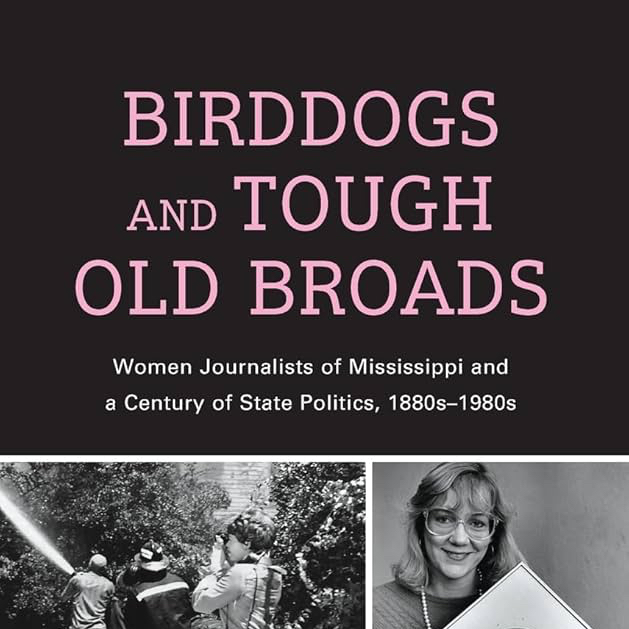
Smith, Pete. Birddogs and Tough Old Broads: Women Journalists of Mississippi and a Century of State Politics, 1880s-1980s. Lanham, Maryland: Lexington Books, 2023, 416 pp., $125.00 (hardcover). Reviewed by Myna German, Mass Communication, Delaware State University, mgerman@desu.edu
Are you interested in the history of journalism in Mississippi, a battleground for many social issues? While the state tends to be more conservative, women got a chance to pursue reporting careers early due to many conflicts, wars, and sometimes a shortage of male reporters. Dig in your heels, and you will read a good history of the women’s movement, civil rights, and state lore in Birddogs and Tough Old Broads: Women Journalists of Mississippi and a Century of State Politics by Pete Smith.
The book brings to light many hitherto unknown facts and associations, which is why I found it interesting. Many of the reporters came from old-line, established professional families and were called on to take a stance on social issues that may have been uncomfortable to them and not discussed in the homes they grew up in. To succeed, they had to break away and be critical thinkers of a way of life that was second-hand to them. Some rose to the occasion—some did not and molded their opinions to fit in with the town fathers and the groups they had to live in.
The author, Pete Smith, an associate professor in the Department of Communication at Mississippi State University, organized Birddogs and Tough Old Broads into eight chapters, excluding the Introduction and Conclusion. Each chapter focuses on a specific woman reporter who covered Mississippi State politics from the 1880s to the 1980s. Smith focuses on the intersection of politics and journalism in what he calls a “closed society” (p. ix), understandable only to the inhabitants.
The book begins with journalists Norma Fields and Ellen Ann Fentress. For three decades, fields covered Mississippi state politics for newspapers like the Capitol Reporter and the Northeast Mississippi Daily. Fields, the first full-time female state capitol correspondent, wrote about shenanigans in the state highway department, much to the dismay of the Highway Commission. As a beginning reporter fresh out of college, Ellen Ann Fentress met the seasoned correspondent Fields in the 1980s. Fentress, the author of The Steps We Take: A Memoir of Southern Reckoning, recalls that their commonality centered on the First Amendment’s power and that Southern women were not supposed to have strong opinions, but both did.
Nancy Stevens, a reporter at the Press-Register in Columbus, Mississippi, covered the Freedom Summer of 1964, while Maine native and Cornell University graduate Nancy Povich reported for the Jackson Sun. All the correspondents had to deal with issues of white supremacy and racism. Insiders, especially Yankees like Povich, were always considered more credible than outsiders.
A prominent figure in the book, Kate Markham Power wrote about the 1893 World’s Fair in Chicago for her editor-father in the Daily Clarion-Ledger in Jackson. Despite her influential position, she opposed women’s suffrage, arguing that it undermined the image of the white genteel lady. As a socialite and the daughter of a leading newspaper owner, Power had to navigate the delicate balance of loyalty to family and local tradition to gain acceptance.
Women reporters had to fit in with society, and they did to get their job done. Had they taken an unpopular stance, they would have been ostracized and unable to work. So, they did the best they could. Some believed the Jim Crow propaganda, others did not, but in a “closed society,” you had to fit in. It would have been a sudden social death to them and their families, including their parents, if they did not.
Smith delves into the childhood of each woman and how they were influenced by powerful and curious parents, particularly their fathers, to have adventures and make a mark for themselves. The book discusses how they reported on the various governors—some were soft on them, some hard, and some used journalistic principles like “working the sources.” Many had fathers who clipped out newspaper articles of them and were very proud, beyond what was expected of fathers in that day. They even treated them like sons. According to one source, some of the women would have gone into politics (p. 315), but as females, this didn’t fit into the “closed society” of the South. Instead, they found influence in commenting on politics, for in Mississippi’s small towns and cities, the newspaper editors/columnists’ opinions were critical in vote-getting.
Each chapter is thoroughly researched and cited and includes articles researched in newspaper archives and holdings in the state. It spares no bones in documenting their contribution to the darker side of journalism and politics and their support of local activism. As journalists, they pointed out politicians’ lies and foibles, but they also, at times, supported the patriarchy and white supremacy all around them.
Smith covers mostly white women journalists but includes Ida Wells-Barnett, who helped facilitate anti-lynching journalism as early as the 1800s. Ironically, none of the women covered had the main problem of northern female reporters–relegation to the women’s pages of major city newspapers. Perhaps it was due to the sparse population of educated women in the South and the need to use every resource carefully, but the book does not discuss that reason. As reporters, they all had popular State House and City Hall beats. The book contributes significantly to women’s history and journalism. It could be used as a textbook in a women and gender studies course or journalism history.
Smith’s book is well-conceived and documented. Its significance is that it covers a long span of 100 years, written by a Southerner with access to local sources that others may not have. The book fills a unique niche in southern regional studies alongside authors such as Eudora Welty and James Faulkner. While these writers have appeared as analysis subjects in Southern Literary Studies journals, female reporters have not. Journalism history focusing on women is relatively new to the academic writing scene, while literary writers have been well-covered. To that extent, the book fills a necessary gap.
 Journalism History journal