
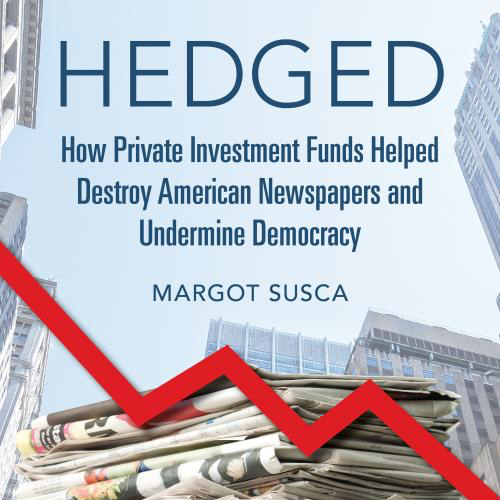
 For the 140th episode of the Journalism History podcast, journalism researcher and former reporter Margot Susca delves into the destructive practices of private equity firms on newspapers, highlighting the urgent need for a thorough understanding of this history in safeguarding our democratic society.
Margot Susca is assistant professor of journalism and associate editor of the Investigative Reporting Workshop at American University. Through a critical political economy lens, Susca researches media investment and ownership, local news and civic engagement, and emerging business models. She is the author of Hedged: How Private Investment Funds Helped Destroy American Newspapers and Undermine Democracy.
Transcript
Margot Susca: There has to be a commitment to mission, to journalistic mission in a democracy. That has to be what distinguishes what journalists do compared to what every other form of information online and on social media does.
Ken Ward: Welcome to Journalism History, a podcast that rips out the pages of your history books to reexamine the stories you thought you knew and the ones you were never told.
Teri Finneman: I’m Teri Finneman, and I research media coverage of women in politics.
Nick Hirshon: And I’m Nick Hirshon, and I research the history of New York sports.
Ken Ward: And I’m Ken Ward, and I research the journalism history of the Great Plains and Rocky Mountains. And together, we’re professional media historians guiding you through our own drafts of history. Transcripts of the show are available online at journalism-history.org/podcast.
This episode is sponsored by Lehigh University’s Department of Journalism and Communication, inspiring the future makers.
(01:03): The colonial. The partisan. The penny. Those familiar with journalism history know that these are some of the early eras of American newspapering. Each with its own unique economic, social and cultural traditions. They’re heuristics for contextualizing our work. And while different historians may draw the lines between each era differently, or sometimes even propose new eras to be added between the better-known ones, they’re essential to our collective understanding of journalism history.
Today’s guest is one of those people I just mentioned, someone who thinks it’s time to add a new era of journalism to the canon. But she’s tacking it on at the end, meaning this episode veers into a type of history we don’t often get on the show, that being contemporary history. The guest is Dr. Margot Susca, assistant professor of journalism, accountability and democracy at American University.
She’s here to describe what she identifies as a uniquely twenty-first-century era and one that’s at the core of her new book titled Hedged: How Private Investment Funds Helped Destroy American Newspapers and Undermine Democracy.
(02:12): Margot, welcome to the show. Now, your book is a little different from a lot of the research that we feature on the show because it’s squarely focused on what a lot of us would call contemporary history. And it’s a story that’s still unfolding, but you mention several times in the book that you approached the story of this private investment takeover of the industry from a historical perspective and with an eye toward kinda connecting the past 20 years with this broader, more established canon of journalism history.
So how should other historians listening to the show understand how your research here fits in with the rest of the story?
Margot Susca (02:47): Yeah, thank you for having me and thank you for the question. I think as a former journalist and as a scholar of journalism and as a teacher of journalism, you know, these last 20 years, it was really important for me to use both investigative journalism techniques but also communication scholarship to kind of put a, you know, put something on this past 20 years. You know?
And for me, after I started doing the research, and after, you know, months and months, which I think that all of us can understand, the thing that made the most sense to me was that this is really, in my view, a historic era, and I think that when we look at past eras of journalism history, they really speak to, I think, the economic, the social, and the cultural moments. Whether that’s the colonial era, whether that’s the partisan press era, whether that’s yellow journalism, or you know, the mass market era.
(03:49): So I was really thinking about this in terms of, you know, over the last, you know, 200+ years of the United States as a nation and considering the moments of journalism history within our development as a nation, in my view, these last 20 years, which are, you’re right, contemporary history, the book is a contemporary history, but in my view, these last 20 years are so crucial in the history of the United States newspaper history and will be so fundamental in understanding what went so drastically wrong in the U.S. newspaper market.
And I think what has gone so wrong in how the news media has been able to serve local communities and democracy that it was really important for me to find a way to put some context around that. And the way that I arrived at that was all of this, you know, what I call the private investment era, which I say has five distinct features.
Ken Ward (04:53): Okay. So let’s- let’s dig into that, that period that you’re talking about. So, if I remember correctly, you kind of framed the previous era as this mass market era-
Margot Susca: Yeah.
Ken Ward: … through covering most of the twentieth century-
Margot Susca: Yeah.
Ken Ward: … so where does this story of this private investment era begin? How would you start the story that your book tells?
Margot Susca: Yeah. So I say that it begins really in 2003. And that’s not to say that private investment funds, which include private equity firms and of course hedge funds, like Alden Global Capital, which a lot of your listeners probably have heard of ’cause it gets, I think, the most attention. Um, but I say that it really begins in 2003, with the sale of 40% of a very profitable newspaper and television chain called Freedom Communication, which at that time owned the Orange County Register.
(05:47): And Freedom Communication was a family-owned chain, the Hoiles family, and when – by the time that it had reached the fourth generation, the family was ready to sell. And there were offers from a number of big players in the newspaper industry. Names that would seem familiar to many of your listeners, Gannett, among others. And the deal that they took was they decided to sell a huge chunk of the company to two private equity firms. Blackstone was one and Providence Equity Partners. And what you start to see, and because I used bankruptcy court records to trace this time period, is that in a very short amount of time … within a couple of years, they took a bigger share of Freedom Communication, is that they were still very profitable.
(06:44): They were still making very, you know, hefty profit margins at the time. But that they started to have to be beholden to those private equity firms, which are notorious in every sector that they belong to, every sector they operate in, whether that’s media or whether that’s housing, or, you know, whether that’s hospital chains that they’re involved in, they’re notorious for trying to just maximize profit at any cost. And that’s what we start to see happen.
So I say the private investment era really begins in 2003 when the deal is struck, in 2004 when it finally, you know, finalizes. And from 2003, I look at that 20-year period to see really the influence of private equity. That was, I say, the canary in the coal mine, that Freedom Communications deal. There was no turning back. Private equity was in – they’re deeply involved in the newspaper industry. Fortress Investment Group, a New York City private equity firm, buys the GateHouse newspaper chain. You start to see private equity investment in the Knight-Ridder chain. Um, and then it just – it becomes an explosion from there.
Ken Ward (08:01): Well, and I think you’re right. These are names that a lot of us who have a background in journalism are familiar with. Right? Fortress bought GateHouse. I worked at a GateHouse paper soon after that, right?
Margot Susca: Oh, wow.
Ken Ward: And saw some of the things…
Margot Susca: Yes. Yeah.
Ken Ward: … that were happening, right? That was my entry into the industry. And so a lot of people have heard these names, and know that they have kind of a – well, at least a shadowy, shady reputation, in a lot of cases are very a dark history for a lot of us … Do they have a playbook? Like what patterns did you identify in terms of how they maximize profits and what were the effects at the papers?
Margot Susca (08:38): Yeah. So I think this is a great question and thank you for asking it. I borrow the term from Phil Meyer’s work where he talks about, you know, harvesting for profits. And I kind of look at that term and I call it overharvesting as one of the five features of the private investment era, which is in many ways, and for those who are journalism historians, we know that profit has been a part of the American newspaper market going back to the days of Benjamin Franklin. I mean he got very rich off of his, you know, ownership of the Philadelphia Gazette. And you know Hearst and Pulitzer. I mean these are names we still know today from their wealth owning the newspaper industry.
(09:21): But the playbook of private equity firms is really just a complete – when I say overharvesting, that is an absolute slash and burn mentality. There’s no reinvestment in any of the newspapers that they buy. And I did for the book 124 interviews, and three dozen of those were with former journalists, several of them were at GateHouse papers. And they talked about what it was like when GateHouse became their new owner. Um, you know, it was content management systems were switched that didn’t run video. You know? In the mid-2000s and 2010s, I mean that was a basic feature. I mean by then, people expected to have video online.
(10:07): Newsrooms were closed or moved, you know, from the center of the community into smaller offices way outside where it really cut off community engagement. Um, and layoffs, which is another feature, I say, of the era. Because of course personnel is your biggest line item for any business. And that I think has been the most devastating consequence of the last 20 years is just the absolute, you know, the removal, the complete loss of personnel, journalists who can keep a watch on local state government officials, regional government officials. And whether that’s the mayor, whether that’s the county commission, you know, there has just been an absolute loss of – a gust out the door of journalists.
(11:06): And I think that that is really, for years to come, we are going to feel the effects of that loss of journalism on democratic society.
Ken Ward: So you’ve touched on two of those themes, two of those five themes that you really focus on in the book. A couple of these others, I think, are more difficult for a lot of us who don’t focus on this type of research to understand. And those are consolidation and the use of debt. And that second in particular is a really important part of the history that I think is really difficult for a lot of us to understand. Can you, as simply as you can, how has debt been used in these past 20 years to lead to this change that we’ve seen in the industry?
Margot Susca: Yeah. So this was – and again, I think part of in writing this book and in talking about journalism history, the importance of journalism history, I think that for many of us, and when I say, you know, whether or not we’re journalism historians or journalism teachers, I think that there’s this conventional wisdom that, you know, the internet … it’s like, “The internet got turned on and journalism died.” You know? And the loss of internet – the loss of advertising revenue to the internet meant that newspapers died. And that’s conventional wisdom. And you know, I think for me, having been, you know, working in a newsroom, I knew it was more complex than that.
(12:31): And I knew that it was not just, you know … it wasn’t just Craigslist, it wasn’t just eBay, that there was – it’s as if these forces just happened to the industry and that there was no – there’s never any discussion of the decision-making behind what went so wrong. So, for me, when I did all of, you know, looked at bankruptcy records and looked at the Securities and Exchange Commission files over the last 20 years, I don’t want to minimize the loss of ad revenue to these online advertising sites or you know, the Monster.coms of the world, but I wanted to try to put the loss of advertising revenue in a timeline.
And for me, what you see is that private equity investment was so crucial, because these private equity investors start demanding more and more profits. They want the same returns that they were getting when the internet was not a factor. So they start putting more demands on newspaper ownership. What they choose as a strategy is not innovation, what they choose as a strategy is mergers and acquisitions. So you see the McClatchy/Knight Ridder merger, you see GateHouse, for example, just buying up newspapers all over. You see newspaper companies, MediaNews Group, which was privately owned at the time, but trying to get bigger and bigger and bigger as a strategy.
(14:04): To your earlier point, what happens is they now these newspaper companies are saddled – Journal Register is another which had an Alden influence. You start to see them saddled with billions of dollars in debt. Now that loss of advertising revenue is meaningful for more than just changing the industry. That loss of advertising revenue is meaningful because these companies are literally drowning in that debt.
So that was for me – I wanted to put the loss of internet revenue or internet ad revenue or the loss to the internet sites, I wanted to try to make that timeline make more sense … because it just had become conventional wisdom in a way that let, I think, the ownership of these newspaper companies a little bit off the hook in my view. So the debt really became fascinating for a couple of different reasons. One, it was because of pressure from private equity investors. And the second is that it becomes its own – there’s a certain kind of subgroup of hedge funds that operate in what’s called the distressed debt market.
(15:29): So that’s where you start to see newspaper companies get targeted by then Alden Global Capital, a couple of others, Oaktree is another, Aurelius. And you see a small group of hedge funds fighting over ownership of Tribune after its bankruptcy in 2008. So hedge funds don’t just play a role as owners, but they play this role as both investors, and, you know, trying to get access to the pieces of these companies after they had been in debt.
So these features of overharvesting, and mergers and acquisitions, and the debt really then play a role, you know, in this cliff that gets … (laughs) everyone in the newspaper companies kinda fall off the cliff. And then you have layoffs, and then ultimately what I talk about are these neglected audiences or communities that stopped subscribing. People in communities who stopped subscribing because newspapers stopped giving them the product they promised, which was local news. So I hope that answers your question.
Ken Ward (16:35): Oh, absolutely. No, it does. You did a great job. And I wanna key on something you said earlier, ’cause you were kinda saying you wanna make sense of the impact of ad revenue within this larger context. And I think that’s crucial. There are a couple other things that I’m trying to make sense of. And one of them is how, you know, there’s a character that’s come in my research quite a bit, Dean Singleton. You mentioned him quite a bit in your book. Uh, he has connections with a couple of these companies and with Alden, eventually.
In a lot of the history, Dean Singleton, especially, you know, in the ‘80s and ‘90s, is not looked on as a positive character in journalism history. The people who worked at newspapers had a lot of complaints. And now, as you mention in the book, his reputation is much different. It’s been reframed, and he’s almost kind of a beacon, at least in Denver, when it comes to the way he handled his papers. Can you talk a little bit about the way that the history of some of these characters has changed and that reputational shift based on what came in this later era that we’re either experiencing or as we’re passing through?
Margot Susca (17:39): Yeah. I think Dean Singleton is such a fascinating character, and I think that he’s, in my view, almost a Sisyphean character because he just, you know, grew and grew and grew. He certainly knew what he had in the Denver Post, which was a great, you know, regional newspaper. He knew that he had … And he knew that he had essentially … I don’t wanna say monopoly, because that’s not what it was.
But he had a force, an advertising force in the Denver Post, right? A strong, you know, churning, profitable paper in the Denver Post. But I talk to … on the record, I talked to one of his, you know, a journalist that had worked for Dean Singleton, for MNG, so that’s MediaNews Group in Vermont, and he was like, “We basically had the water cooler was removed, the 401(k) was taken-
Ken Ward: (laughs)
Margot Susca (18:31): … you know, taken away.” Like this was not a person who was a Dean Singleton fan. And he had cut so much, again, before private equity influence, before hedge fund influence, that he had gained the nickname “Lean Dean.” Right?
So you’re right. I mean he had this reputation for being a notorious cost cutter. And I used him as an example to say like, “I am not so naïve to say that there weren’t cuts in newsrooms, that there weren’t … signs of other problems in newspapers chains.” But I think that Dean Singleton, it’s almost like, you know, for some, I don’t mean to make it about politics, but it’s like if you look at the current state of politics today, and you remember maybe if you’re a person who may identify as a liberal, and you think back to the conservative politics of 20 years ago, and you think back like, “Well, wow, I would really take that, you know, over-
Ken Ward: (laughs)
Margot Susca (19:28): … what’s hap-” you know what I mean? Like over what’s happening today. That’s the way I think of Dean Singleton. Dean Singleton saying that Alden Global Capital is really like the worst possible thing that could happen to journalism is wild to many people, because many people in many of the communities where there were MediaNews Group papers, you know, had experienced similar cuts. And workers at those papers remember him being a notorious cost cutter. But he at least … gosh, I mean, at least he respected, I think, he respected the news business. He respected the news industry. But he was very wealthy. I mean I mentioned the Columbia Journalism Review piece that talks about his home having 11 bathrooms, and him having a private jet. I mean, he’s a wealthy person. He was made wealthy from his newspaper ownership.
(20:24): But this hedge fund ownership is a new kind of wealth. And whether or not they’re buying and selling assets of newspaper companies, or buying and selling, you know, widgets, these hedge funds don’t care. I mean that I’m sure of. I spent three years going through these documents and reading about them, and it’s clear to me that these are companies that don’t care about sustainability, they don’t care about community news. They would lay off, you know, anyone in order to make a buck.
Ken Ward (21:01): Well, so- and you just- you’d mentioned that ultimately maybe Singleton respects journalism, right? Is that – for those of us who are trying to understand where this fits in to this, you know, broader history of journalism, is that what distinguishes what you identify as the past era with the present era? Is it just that these private investment organizations, they don’t respect journalism, and the way that even though those in the past were, “Cut, cut, cut,” they still saw- like they understood the value of the product even if they were going to wring everything out of the product that they could?
Margot Susca: Yeah, and I think this is such a key question. Right? Which is I think that there has to be a commitment to mission, to journalistic mission in a democracy. That has to be what distinguishes what journalists do compared to what every other form of information online and on social media does. Because anybody with a TikTok can put out whatever they want, right? I mean, so I think that this distinction of, you know, and I don’t know if it’s the respect for journalism, but there has to be, in my view, again, I’m a professor of journalism, so of course, this is my view, and this is the lens by which I will look at it, which is there has to be a sense of mission by the organizations that take on, you know, the yoke of doing this kind of work.
(22:31): And there has to be accountability piece, which is holding governments accountable. Whether that’s a local government, a state government, or you know, a federal agency or institution. Because if there isn’t, what will distinguish a professional journalist from, you know, my daughter and her crew of 13-year-old friends on TikTok walking around-
Ken Ward: (laughs)
Margot Susca: I mean I’m not, again, I’m not against, you know, people having access to technology and being able to be a voice. But how do you trust that? There has to be some, you know, some verification, some level of … that has to be restored. I don’t know that I have the solution for how we can regain that, but I think as we look ahead toward a future of AI and where technology is just gonna keep getting crazier, I don’t know, for lack of a better word here. I think that we’ve gotta have some return to, you know, trusted sources that are acting in citizens’ best interests.
(23:49): And so I think that mission has to be part of it. It just can’t be anybody with a tripod and an internet connection. I just don’t believe that. I think it has to be … let me correct myself and say I think there’s some really interesting work that’s being done to train citizens to do, you know, work, going to meetings, and tracking public meetings … but that’s done through, you know, they’re being trained on how to do that. So maybe I just contradicted myself. But we’re –
Ken Ward: (laughs) I don’t think so.
Margot Susca: … I think- I think-
Ken Ward: I don’t think so.
Margot Susca (24:33): You know, I think we’re really – I guess what I would say is I think all of us, whether you’re a historian or a former practitioner like you and me, you know, or looking ahead and wondering what this moment, the end of this last month of January, all these layoffs, like we’re certainly at an inflection point. And I think everyone is waiting to see, like where is this moment, what is gonna happen … when is it gonna end and … what’s gonna lie ahead.
Ken Ward: Absolutely. Well, with that specifically in mind, so like our time is getting short, but I wanna ask you, you know, what should we as historians, those of us who do historical research, many of us whom do research in eras far removed from this contemporary history, what should we take from this?
Margot Susca (25:31): Well, you know, I think that there’s something to be said about rethinking conventional wisdom about the period of time that you know about, right, or that you study. And I think that the use of records and documents and as we are getting better at being able to use archival research, and as that has become more accessible, you know, I would say like what is the dominant narrative of the period of time, you know, that you have looked at? And where is there a little bit of light that you might be able to kind of carve out some space, and you know, there’s a historian whose work I cite, who looked at – whose work I thought was fascinating about looking at how newspapers profited off of the sale of advertisements, you know, that ran advertisements based on the sale of enslaved people.
(26:30): And I just thought like, “Wow, like that research didn’t come out until just a few years ago.” And that to me was a fascinating body of research. You know? Interrogating early colonial newspapers. And newspapers into, you know, eighteenth century and nineteenth century newspapers. And I just thought that was a really interesting bit of work. So for me, I just think, you know, what is the conventional wisdom in it?
Is there some archival research or new database that you can get access to that might be able to either expand or, you know, maybe even cut through, find a little bit of light in that area that might shed some new understanding or new context in that space. And maybe help us understand something new about that period of history that we may not know about yet.
Um, or like, you know, something, taking one thing and just blowing it up like one city, you know, I love that. I love like that deep dive into one issue. I just think that’s so fascinating. And I think there are so many more stories out there in American journalism history that haven’t yet been told.
Ken Ward (27:52): Well, so speaking to that, right? We have one last question that I wanna ask you, I ask it to all of our guests, and so I’m excited to hear what you have to say. Why is it that journalism history matters?
Margot Susca: Well, I mean it’s the adage of, you know, what is past is prologue, right? And I think, for me, I think you understand power, government, citizenry by understanding journalism history specifically. You know? And teaching my students about Ida B. Wells helps them understand the whole new understanding of, you know, institutional racism, about understanding voting rights, about understanding violence, about understanding early data journalism, really, right?
(28:43): I mean Ida B. Wells in many ways was the first, you know, or a pioneer of data journalism at the end of the nineteenth century. So that’s what I would say is, you know, I think that we have to engage with journalism history because it helps us to understand American history. And I think it helps us to understand power, and I think that that is crucial in a democracy to understand who has power, who had power, and to help us maybe understand how we can – how it will shape who has power in the future.
Ken Ward: Well put. Well, Margot, that’s all the time that we have, but I wanna thank you one more time for being on the show. Great conversation-
Margot Susca: Okay. Thank you.
Ken Ward: Thank you so much.
Margot Susca: Thank you for your time. Thank you.
Ken Ward (29:28): Absolutely. Well, that’s it for this episode. Again, the book is Hedged: How Private Investment Funds Helped Destroy American Newspapers and Undermine Democracy. Thanks for tuning in and be sure to subscribe to our podcast. Until next time, I’m your host Ken Ward signing off with the words of Edward R. Murrow, good night and good luck.
 Journalism History journal