
2023-12 | Download PDF
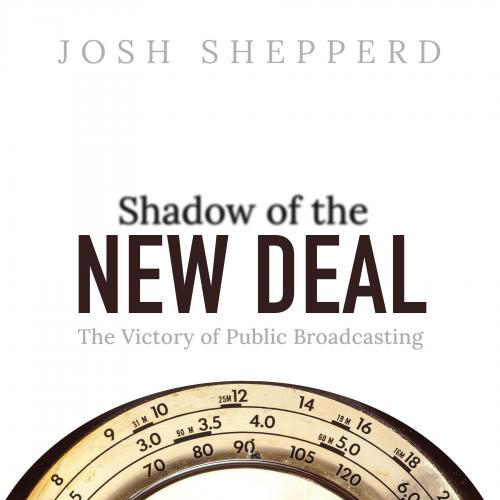
Shepperd, Josh. Shadow of the New Deal: The Victory of Public Broadcasting. Champaign, IL: University of Illinois Press, 2023, 244 pp., $28 (Softcover). ISBN: 9780252087257. Reviewed by Jason Lee Guthrie, Communication and Media Studies, Clayton State University, jasonguthrie@clayton.edu
Funding for American public broadcasting is regularly questioned today as part of partisan political wrangling. Conservative administrations since Nixon have challenged the notion of public media as a public good and pitted the tax-payer-funded system against the alleged efficiencies of the free market in straw man arguments that play well to their voting base. Yet despite these very real threats, in his new book Shadow of the New Deal: The Victory of Public Broadcasting, Josh Shepperd finds much in the history of public broadcasting that can inspire hope for the future of American democratic life.
The hopeful tone that pervades this book is evident from its opening chapter. Shepperd is particularly interested in how American public broadcasting emerged from a set of civic ideals to become a sustainable industry – a transition that he characterizes as a move from activism to advocacy. That transition happened between the Communications Act of 1934 and the Public Broadcasting Act of 1967, with the majority of Shepperd’s focus being given to the period between 1935 and 1952. During that time, a diverse group of university faculty, radio industry insiders, and philanthropic funding organizations haltingly forged a path forward. In the process, they codified many foundational principles defining public media today.
Shepperd’s expansive archival research produces rich, though at times dense, narratives. Chapter one, Advocacy, might have benefitted from the more narrative tone used in the Introduction, but it provides a wealth of information about the lead-up to the 1934 Communications Act, why education-minded activists were largely unsuccessful in their bid for public airwave allocation, and how they retooled their strategies after the Act’s passage. Chapter Two, Funding, focuses on the grant money, largely from The Rockefeller Foundation, that made retooling the strategy possible and how the fusion of private philanthropy with public media formed the basis of the business model that became the Corporation for Public Broadcasting.
Chapter Three, Distribution and Facilities, uncovers the understudied history of how early university broadcasters formed their own patchwork partnerships and proto-networks to pool their meager resources. Along the way, production best practices for educational material became codified into what is commonly called media literacy in academic circles today. Chapter Four, Research and Development is similarly situated in the Academy and sheds new light on the fraught relationship between Paul Lazarsfeld and Theodor Adorno. Shepperd’s account of their brief partnership under the banner of the Princeton Radio Research Project adds important nuance to the story of how these two individuals came to personify the quantitative/qualitative divide in Communication research.
Chapter Five, Policy, demonstrates how early activism became strategic advocacy that produced new public policies. The very idea of public airwaves strikes at the heart of tensions between capitalist tendencies and democratic ideals, but the history of public broadcasting in the United States shows that these tensions can be resolved in mutually beneficial ways. Shepperd’s conclusion reinforces this and asks the reader to consider its implications. When possible, historical research should focus on moments of positive change and help to decipher how the change was made. This point is driven home especially well by highlighting the role of prominent early academics in communication and media studies in influencing the trajectory that public broadcasting eventually took.
Shepperd knows his likely audience well. This book is a clear call for communication and media scholars to apply their research in ways that can have a tangible impact on civic life. Graduate students in courses on media history, communication, and media theory or graduate seminars designed to prepare candidates for careers in higher education will particularly benefit from the material in Chapter Four, though it does presume a fair bit of prior knowledge about the history of the field. It helpfully reframes what is often cast as an ontological dichotomy at the heart of the discipline to consider instead the ways diverse methodologies can be put toward solution-focused outcomes. In that way, this book adds to the work of scholars it features, such as Harold Lasswell, Wilbur Schramm, and Dallas Smythe, as well as to James Carey’s considerable work on communication education and Robert McChesney’s histories of broadcasting. By adding to this existing body of work, and especially by maintaining a hopeful, inspirational outlook about the possibilities of communication and media studies research, Shepperd has made a substantial contribution to the field.
 Journalism History journal