
2023-11 | Download PDF
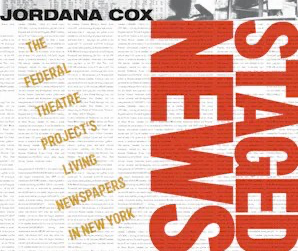
Cox, Jordana. Staged News: The Federal Theatre Projects Living Newspapers in New York. Amherst, MA: University of Massachusetts Press, 2023, 170 pp., $29.95 (paperback). ISBN 9781625346797. Reviewed by Andy Bechtel, Hussman School of Journalism and Media, University of North Carolina at Chapel Hill, abechtel@email.unc.edu
The decade of the 1930s is notorious as the era of the Great Depression. It’s also noteworthy as a time when American newspaper journalism was in turmoil — not only because of financial pressures but also due to competition from radio and news reels.
Staged News connects journalism to the politics and economic policies of the era by chronicling the brief history of Living Newspapers. This New Deal government program brought news from the printed page to live performances on stage — and from readers in their homes to audiences in theaters.
Jordana Cox, a professor of communication arts at the University of Waterloo, draws from her previous research on Living Newspapers that was published in academic journals in several disciplines. Staged News expands that work into a deeply researched and deliberately paced book, showing how the journalism of the past reflects the journalism of the present.
Cox recounts how the Living Newspapers project presented another new way to convey news and information. Like journalism itself, the government program also faced accusations of bias from political opponents of President Roosevelt’s New Deal policies. Indeed, the Living Newspapers program ended in 1939 amid political pressure and accusations that its members were sympathetic to communism.
Operating from 1935 to 1939 as part of the Federal Theatre Project, Living Newspapers merged the practices of journalism and the theater. Cox describes how the program took on complicated topics and attempted to explain them to a broad audience through theatrical narratives. Subjects included housing, safety regulations and access to utilities. In this sense, productions such as Triple-A Plowed Under and Injunction Granted! represent a kind of storytelling.
Cox recounts how Living Newspapers worked similarly to real newsrooms of the time: a staff generating story ideas, reporters researching topics, and editors shaping the resulting stories for presentation. This structure was in part because many of the program’s staff, including former Associated Press reporter Morris Watson, had newspaper backgrounds.
The author, therefore, argues that Living Newspapers productions were news but with a twist. “They resist powerful journalistic norms or, more specifically, distinctions: between objectivity and bias, bearing witness and taking action, propaganda and democratic communication, public interest and exclusion,” she writes.
Several chapters of Staged News recap and critique individual productions, with archival photographs and illustrations adding glimpses of staff members and performances. Cox analyzes two productions in particularly insightful ways to illustrate how Living Newspapers were a form of news but also a form of commentary about the nature of journalism itself.
First, she takes a closer look at The Events of 1935, considered one of the less successful efforts of the Living Newspapers program. Unlike other productions that took on a single issue, 1935 was a year in review of numerous events. It included a “court of public opinion” — actors in a “jury box” on stage, serving as an audience for news events and expressing how they felt about the importance of a topic or event.
Contradicting critics at the time who called the “court” a gimmick, Cox makes a convincing case for why it was provocative and innovative as a challenge to the audience, making 1935 a significant work. “The jury as gimmick juxtaposes the phantom public, enshrined in liberal-democratic theory, with the disappointing reality of a mass polity,” she writes (77).
Second, she reveals a flaw in Living Newspapers: they suffered from racism and stereotypes not entirely different from what we see in the news today. The production Liberty Deferred, which took on the issue of lynching and called for direct action to confront Jim Crow, never made it to the stage.
The author points out how playwrights Abram Hill and John D. Silvera didn’t receive the support from research staff and production teams that other Living Newspapers had. As the production developed, leaders of the Federal Theatre Project were anxious that it underplayed success stories for Black Americans and overplayed white oppression.
In that chapter and elsewhere, Staged News contributes significantly to the contemporary debate over objectivity in news. Then, as now, Black writers were seen as unable to report or portray race in an objective manner.
Additionally, leaders of Living Newspapers saw the productions as “propaganda for democracy” (87) — a phrase that drew skepticism from members of Congress. We hear the same sort of commentary today about the role of news organizations defending democracy versus “hearing both sides.” These reflections of then and now make Staged News especially relevant.
Staged News hints at what “living newspapers” might be like today. In recent years, there have been efforts to restart the genre in places such as Chicago and London, but not a full-fledged revival on the scale of Living Newspapers. In that way, Cox’s book will be of interest to scholars of journalism history and the history of the American theater. Staged News would work well in a graduate-level course in either historical discipline.
Although a government program supporting such productions seems unlikely, it’s fascinating to consider what they would look and sound like, particularly given the multimedia firepower of today’s Broadway performances. If Lin-Manuel Miranda can turn history into the rap-infused musical Hamilton, there’s also a place for journalism on stage as well. Perhaps Cox’s book will inspire such an effort.
 Journalism History journal
1 Comment
Comments are closed.