
2023-8 | Download PDF
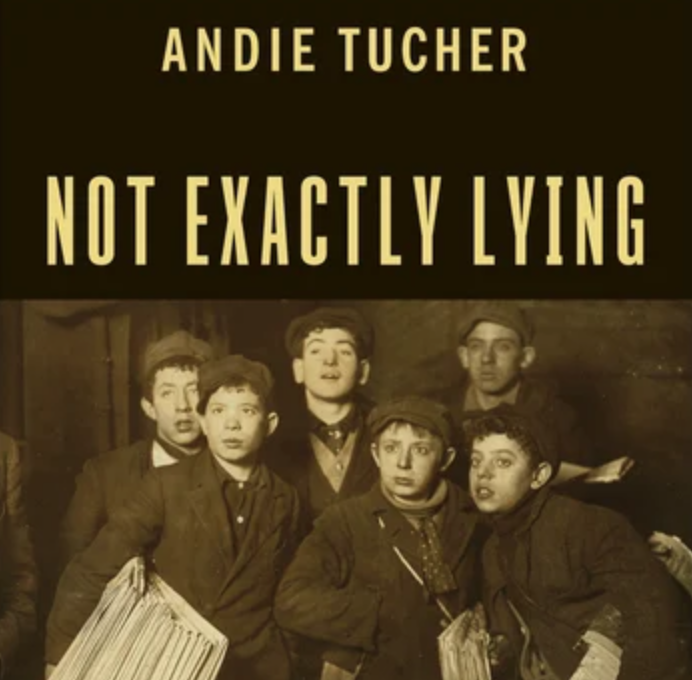
Tucher, Andie. Not Exactly Lying: Fake News and Fake Journalism in American History. New York, NY: Columbia University Press, 2022, 384 pp., $28.00 (paperback). ISBN: 9780231186353. Reviewed by Enrique Núñez-Mussa, Michigan State University, nunezmus@msu.edu
Amidst the growing body of literature on misinformation and disinformation, Andie Tucher’s Not Exactly Lying: Fake News and Fake Journalism in American History provides an original contribution from the field of media history. The book contributes to the debate by presenting a history of American journalism, shedding light on its enduringly tense and complex relationship with the truth.
Tucher’s research, organized into ten chapters, explores the production and acceptance of falsehoods in journalism, examining both the creation of content and its consumption by audiences. While some chapters focus on major historical events, such as the coverage and role of propaganda in the World Wars and the Cold War, the book’s structure allows for cross-referencing and exploring specific themes, such as the challenges of integrating new technologies like audio and images into content production or the transformation of audience’s trust in the news media.
The author delves into the origins of American journalism to show that an ideal or perfect relationship between journalism and truth has never existed. From the first single-edition newspaper, Publick Occurrences Both Foreign and Domestick, to the internet era, the book reveals how journalistic ethics and discourses fluctuate in different social, political, and cultural contexts.
Not Exactly Lying: Fake News and Fake Journalism in American History depicts an unromanticized view of American journalism, offering non-idealized versions of figures such as Benjamin Harris, Benjamin Franklin, and Joseph Pulitzer. It acknowledges their contributions and highlights their contradictions, such as Pulitzer’s pursuit of accuracy alongside sensationalism.
The book demonstrates that exploring the tension between lies and truth in journalism provides a fresh perspective, even when the events have been extensively documented. Controversial cases like The Great Moon Hoax, the coverage of Orson Welles’ War of the Worlds radio broadcast, Janet Cooke’s Jimmy’s World, and documentaries like Nanook of the North and Bowling for Columbine form part of the professional reporter’s imagination and the canon of questionable cases taught in journalism schools. However, when viewed within a broader narrative, a timeline emerges in the form of waves, where discourses, concerns, and conflicts repeat with different emphases, always leading to central questions: Who defines what is true, what constitutes an acceptable truth, and what influences the acceptance of truth?
Without making explicit parallels, the author opens the door to comparisons. For instance, the early discussions on radio spectrum regulation mirror the ongoing debates surrounding social media platforms. Also, solutions that are part of current debates are documented. For example, the Institute of Propaganda Analysis, from 1937, attempted to provide media literacy and stopped operating when its mission could undermine American efforts in World War II, showing how political contexts impact what is considered priority informational needs by those in power to decide.
The book draws on various documentary sources and complements them with recent academic works. The meticulous analysis of press coverage from each era sheds light on why certain information was not genuine, denoting a comprehensive contextual reconstruction. While sparingly used, crucial visual examples enhance the depth of the cases examined, such as the “composographs,” early examples of image manipulation.
The historical review serves as a tool to contribute conceptually to understanding misinformation and disinformation. The book reveals that the expectation of factual content in newspapers emerged only at the end of the 19th century, making journalists responsible for that accuracy. Before, the audience tacitly agreed with the media, assuming that certain stories or “humbugs” were false. Speculation about the veracity of the stories was part of the media’s objective. Therefore, Tucher proposes a distinction between untrue and fake journalism, with the latter term arising when the public expects truth from journalistic content.
The study treats misinformation with nuance, recognizing fluid and hybrid processes rather than absolute consensus on accuracy. It acknowledges the abstract nature of understanding public expectations and the role of truth within journalistic work, highlighting that content is not independent of its circulation and validation circuits. Additionally, the study acknowledges the fragility and ambiguity of the reporter’s process when examining methods such as journalistic interviews or the style of “new journalists” as baptized by Tom Wolfe to describe the application of literary techniques into news writing.
Ultimately, Tucher’s argument converges on the present day, considering Donald Trump’s presidency as an exceptional case in the United States, even though the book describes propaganda and disinformation in previous administrations. In this context, the author defends objectivity as a relevant concept in journalism, understood in the tradition of Walter Lippmann’s method of evaluating evidence. It goes beyond emphasizing two sides of a story or disregarding the journalist’s emotions. The argument diverges from trends that dismiss objectivity as a normative principle in journalism. However, it is undoubtedly complex, as the history recounted in the book demonstrates how the objective approach to facts fluctuates at different times. It is also necessary to consider how audiences understand the concept at specific moments. The book discusses the case of Fox News, which incorporated objectivity into its discourse to redefine it through biased and opinionated practices, amplifying voices from a single perspective, and engaging audiences who will expect that to be the standard of objective journalism.
Whether read in its entirety or as individual chapters, it provides valuable material for reflection in courses on the history of journalism, introduction to media, and visual communication. Not Exactly Lying: Fake News and Fake Journalism in American History enriches academic discussion from both historiographical and media perspectives.
 Journalism History journal