
2023-7 | Download PDF
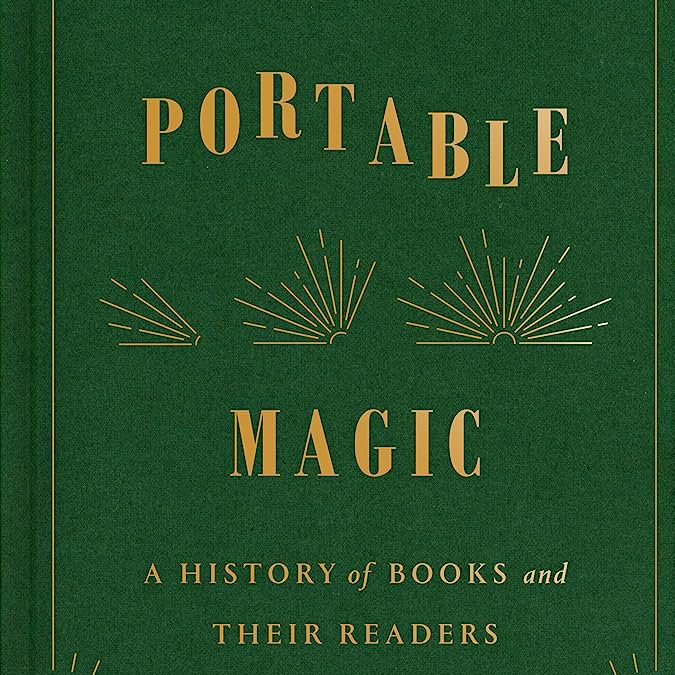
Smith, Emma. Portable Magic: A History of Books and Their Readers. London: Allen Lane, 2022, 352 pp., $24.74 (Softcover).ISBN: 9781524749095, Reviewed by Barbara Ruth Burke, Communication, Media & Rhetoric, University of Minnesota Morris, USA, burkebr@morris.umn.edu
Usually, we think of books in terms of their content. Emma Smith wants us to think about books as meaningful things functioning as semiotic indicators of much more than the words within the covers. Portable Magic: A History of Books and Their Readers promotes an examination of the ways people, over time, have responded to making such ordinary objects into items that create individual, social, economic, cultural, and religious meanings.
Filled with several unusual and charming details and interpretations, this book would be enjoyable for undergraduates who have completed an introductory media history course. It will also serve media historians as a model for making scholarship in media technologies accessible to a broader audience. Portable Magic comprehensively defends the assertion that we can understand books as technical entities that have meaning through how we respond to their physicality. In this extended bibliophilic tale, Smith explains many book-related concerns, including the history of book construction and manufacturing; the ways books are used for and against propaganda; when and how book ownership provides comfort, acts as signification and confers status; various understandings related to book trafficking/collecting/ collectors; the ways communities value or understand the role of library books; book censorship and the “freedom to publish;” ideas about the “work” of readership; and the range of understandings we must navigate when we ask “what is a book?”
As is common in histories about books, Gutenberg’s Bible is discussed in an early chapter. To illustrate the nature of the book’s arguments, beyond the familiar narratives, Smith situates the Gutenberg-funded printing press within a broader, more comprehensive contemporary review of European technologies, the making and marketing of printed materials, details about Guttenberg’s other publishing and marketing activities, European clerical expectations, dominant fonts used in texts, supply chains for book materials, and availability of necessary/affiliated inventions. Furthermore, Smith reminds readers of the persistent mythic, fetishized cultural status and overvaluation of these Bibles when referencing, from the 2004 sci/fi film The Day After Tomorrow, the rescue scene which symbolically saves humanity, progress, and the enlightenment by saving the Gutenberg Bible from the New York Public Library.
The “Titanic and book traffic” chapter, another example of considering books as magical things, is similarly rich in detail and makes a variety of insightful connections regarding “bibliomania” (106-108). In discussing ocean-crossings, book-collecting passions, and the status acquisitions had among newly rich, early-1900s Americans; Smith asserts that owning a personal library became a form of conspicuous consumption that could signal social club-eligible status. Later, book-holding travelers, economic migrants, and refugees carrying books enter the conversation as selected books serve as “diasporic objects” (115) or portable totems for home, safety, or faith. The ship records, manifests, and photos described in Portable Magic combine to further the argument that books function as valuable things, irrespective of content, for many travelers who carry and preserve them.
Smith articulates the concept of the “shelfie” to indicate instances when books are displayed or curated to promote self-image. The history of the shelfie emerges from her careful study of several formal portraits of 17th-century English and French women. The physical placement and arrangement of strategically-selected books and manuscripts within those paintings evoke complex messages and suggest to viewers an assortment of conclusions about the women depicted. The titles in the backgrounds convey key ideas about the subject’s life, intellect, and critical mind interests. The concept of curating books as communicative signals is also effectively applied in Smith’s analyses of the 1950s and 1960s photos of Marilyn Monroe reading or sitting in libraries. Just as the portrait predecessors, to understand Monroe, people have “struggled to reconcile the sexuality and the erudition captured” (84) in posed photographs of her reading Ulysses, or Leaves of Grass, or holding Death of a Salesman, and thus using books as signifiers instead of random props. The modern shelfie sensibility is additionally defended in Smith’s analysis of the Twitter account “bookcase credibility,” which highlights the evaluation and discussion of the commentary that came with book arrangements by color, by size, and with spines turned inward; and by Kondo’s horrifying direction that one should own few books. Again, Portable Magic’s core thesis is supported by detailed historical and contemporary examples.
In concluding arguments about physical books, Smith opines: “Books last, and their long lives sometimes have unexplained consequences” (260). Clarifying that her analysis of the history of books is a study of the history of the form, technology, and material existence of books, while the history of readers is about ways people respond to pragmatic things (and feelings about the things) of a material world. Smith guides us to agree that a book becomes a book precisely because it is an interactive object, conveying functional, decorative, personal, social, cultural, and intellectual meanings.Portable Magic has various appropriate sources from historical works, popular culture, and well-reasoned interpretations and analyses. The writing is clear and compelling, and the logic of arguments regarding physical books and their impact on us is especially strong. By stressing that we should merge our conventional thinking about the contents of books with focused thinking about the form, format, bindings, and portability of books as physical items, every chapter richly supports Smith’s fundamental premises: that book content and form interconnect; and that the reciprocity and proximity of books and their readers create a magical relationship which leaves both parties changed.
 Journalism History journal