
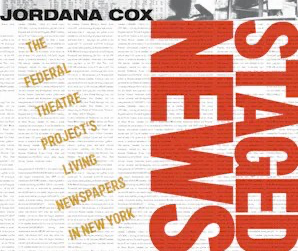
 For the 129th episode of the Journalism History podcast, author Jordana Cox discusses her book, Staged News, about a Depression-era collaboration between journalism and theater to produce news for the theatrical stage.
Jordan Cox is assistant professor in communication arts at the University of Waterloo. Her research bridges communication studies, performance history, and the public humanities.
Transcript
Jordana Cox: The very idea of government-funded theater was controversial, but particularly government-funded theater that addressed political issues was controversial.
Teri Finneman: Welcome to Journalism History, a podcast that rips out the pages of your history books to reexamine the stories you thought you knew and the ones you were never told. I’m Teri Finneman, and I research media coverage of women in politics.
Ken Ward: And I’m Ken Ward, and I research the journalism history of the Great Plains and Rocky Mountains.
Teri Finneman: And together we’re professional media historians guiding you through our own drafts of history. Transcripts of the show are available online at journalism-history.org/podcast. This episode is sponsored by Taylor and Francis, the publisher of our academic journal, Journalism History.
You’re probably familiar with the Broadway show Newsies, which gives audiences a live look from the stage into what the newspaper industry used to be like. But it turns out news and live theater had already merged decades earlier in a forgotten chapter of journalism history. Between 1935 and 1939, the New York Living Newspaper Unit created six living-newspaper theater productions that brought news to the stage. The efforts were funded with federal money as part of Franklin Roosevelt’s New Deal programs during the Great Depression. The most popular show, One-Third of a Nation, ran for 10 months and drew over 200,000 audience members in New York, with additional shows running in other cities around the country.
On today’s show, we have Jordana Cox of the University of Waterloo to discuss her new book, Staged News. Jordana, welcome to the show. I had no idea not only that there used to be theater performances about the news many years ago but also that there currently is an annual living-newspaper festival at the Jackalope Theatre in Chicago. So how did you find out about this topic?
Jordana Cox: By accident and through a rather winding path. I had loved and participated in theater since I was a child, but in college I had studied political philosophy. So I had become particularly interested at the end of college in the relationship between theater and politics and how theater could be a place for people to think together about political issues. So in my first few years of grad school, I was looking all over the place in theater history for examples, and I started out with Greek tragedy, and I looked at the Weimar theater of Bertolt Brecht and the Brazilian theater of Augusto Boal.
And then at some point, I don’t remember exactly when or how, I stumbled on a script of a living newspaper. And it was the most popular living newspaper, One-Third of a Nation, which was about the housing – shortage of available housing, sanitary housing, affordable housing during the Great Depression. And I was really struck by this moment in the play, where a character named the Little Man jumps out of the audience and gets up onto the stage to ask questions to this booming loudspeaker about why he can’t find a decent place to live. And I was so intrigued by this strange and interactive way of engaging with news to think about politics that I dove into living newspapers from there.
Teri Finneman: You note that both the newspaper and theater industries were struggling during the Depression years, not only with declines in revenue from consumers but also the increased competition from newsreels, radio and motion pictures. But how did this idea of turning news into theater productions even come about, and how would journalism and theater even think to partner together?
Jordana Cox: Well, the idea was not exactly a brand-new one, even though many of the makers of living newspapers would claim that it was. Many theater-makers in the U.S., particularly involved in the worker’s movement in the ’20s and ’30s, were inspired by agitprop street performances that they had seen or heard about in revolutionary Russia, where newspapers had began as oral recitations of the news on street corners and workers halls, particularly for workers who were not literate, who could not actually read the news. Living newspapers in revolutionary Russia were popularized by a company called Blue Blouse that eventually traveled outside of Russia, including to the Weimar Republic, where they inspired German documentary theater-makers like Erwin Piscator and later Bertolt Brecht. So some American theater-makers had already gotten a taste of what this form could offer in Europe or through adaptations of this European form.
But the distinctive form that living newspapers took during the Great Depression in the U.S. really had to do with two major labor initiatives that came together – came about kind of at the same time. One of them was an employment initiative serving out-of-work theater-makers, and the other was the beginnings of a labor union for editorial staff, for reporters and editors. So I’ll briefly explain each of those. The Federal Theatre Project was an employment initiative that was funded by the federal government’s Work Progress Administration, also known as the WPA. The WPA funded all kinds of employment initiatives. Among them were arts initiatives, including the Federal Theatre Project, which made cheap theater across the country and at the same time gave jobs to theater-makers who were struggling to find them.
So the Federal Theatre Project had this mandate to put theater-makers to work. At the same time, editorial staff, reporters and editors who didn’t yet have a union were starting to come together and organize themselves to fight for better working conditions. There was a mythology, which I think in many ways has stayed with us today that newspaper reporters, in order to do their jobs well, really had to be left to their own devices and just chase a beat, no matter what it took, to hell with keeping regular hours or getting home to the family or whatever a 9-to-5 job might offer. Editorial staff were starting to question the lack of protections that came with that idea, which circulated in popular film, in popular media. David Welky has written about this in his wonderful book.
So editorial staff were coming together and beginning to form in 1933 what would become the American Newspaper Guild, and one of the early members of the American Newspaper Guild was a guy named Morris Watson, who was fired for his work organizing the American Newspaper Guild from his job at the time with the Associated Press. So Watson was out of a job, and he found himself basically the first person, as far as I can tell, in human history who found a backup plan in a theater career and found himself working for the Federal Theatre Project. And there he would become the managing producer of a group of journalists and theater-makers who would work together to make original plays about the news for the American public.
Teri Finneman: Yeah, so expand on that a little bit in what else journalists were doing. Did journalists just do the writing? Were they also acting, or they left it to the theater actors?
Jordana Cox: Yeah. Journalists did the research and writing, and actors did the acting. And dramatists and directors worked as mediators in between. Arthur Arent, who was a playwright, became particularly important in the Living Newspaper Unit, because he had a knack for finding compelling theatrical ways to convey pieces of reporting. For example, in One-Third of a Nation, the play about housing that I mentioned earlier, Arent wrote a scene in which housing speculation was presented kind of metaphorically in a movement piece that took place on a piece of green carpeting. And so audiences saw through this really compact metaphor of historical figures fighting to stay on this shrinking green carpet, kind of a story of how housing became more and more scarce over time. I should say Arent wrote the scene, but it was choreographed by the Leftist dancer and choreographer Helen Tamiris.
So there were ways in which theater artists interpreted the research and reporting that journalists were doing in what was more or less something resembling a city newsroom with its own morgue that archived old newspaper stories for research purposes and also copy-editors and researchers and writers. The theater folks would take the research done by journalists and then adapt it into the language of the stage. But as you can imagine, even though there was some specialization, over time the journalists began to be able to anticipate what might work well on stage just as the actors and directors began to improvise their own innovations, come up with characters that would then feed back into the script. So there was a little bit of give-and-take, even though the jobs themselves were relatively discreet.
Teri Finneman: You mentioned one of the shows. Let’s talk about some of the other plays and what topics they discussed. And, I mean, is this really the early days of cable news or not quite, where you have live news delivery?
Jordana Cox: There was a lot of trial and error as this group of journalists and theater-makers worked together to try to figure out what kind of structure and approach would make sense for this stage. So they actually went through a few different iterations before they kind of settled on the dramatic structure that they would stick with for a little while. The Living Newspaper Unit’s very first production, which was about Mussolini’s invasion of Ethiopia, was actually canceled, because there was an impersonation of Mussolini himself, as well as Haile Selassie, and representatives from the State Department actually worried that these impressions of foreign political leaders could get them into hot water. So that was an example where some pushback from above would inform the living newspaper’s work. And after the fiasco with Ethiopia, Elmer Rice, who was a famous American dramatist who was involved in the initial living newspapers, quit. He left, crying censorship, but those who stayed in the living newspaper decided that they would restrain themselves to domestic issues in order to avoid the problems associated with impersonating foreign dignitaries or politicians on stage.
After Ethiopia, the Living Newspaper Unit would also experiment with kind of a more vaudevillian variety-type structure, where they presented a whole bunch of news stories really quickly, almost tabloid style, headline first, one after the other in a really fast-moving hour and a half. But the response to that from critics was not particularly positive. Critics kinda felt like the treatment was a little bit too superficial, and they weren’t really getting anything other than a summary of what had already happened. So after that second somewhat failure, the living Newspaper Unit decided that they would focus on doing something that the newspaper, their competitors, and the newsreel and the radio could do perhaps not as well as they could, which was to dive into single issues and really explore them theatrically.
So rather than rushing to try to break news stories as they came in, which was part of the initial vision but really challenging to do in the context of theatrical production, the living newspaper decided that they would focus on extended single-issue treatments on housing, in the case of One-Third of a Nation; on the Agricultural Adjustment Act, which had to do with farm subsidies; on government funding for utilities and the Tennessee Valley Authority. People who know a little bit about New Deal history probably recognize that these were all New Deal initiatives, which was no accident, given that the living newspaper’s funding came from the Roosevelt government. So, ultimately, the productions of the Living Newspaper Unit made were by and large focused explorations of New Deal issues and the policies that were seeking to address them.
Teri Finneman: You’ve talked a little bit already about One-Third of a Nation, which you note was a big hit, with hundreds of thousands of people going to see it. Why do you think that show in particular was so popular?
Jordana Cox: It’s a really good question, and as is the case whenever we try to figure out why something is popular, there’s a little bit of speculation involved. But I think that there were a few factors that were particularly important. One, to state the obvious, was just that housing was a really pressing issue. The play opens with a tenement fire, and as the loudspeaker, the kind of narrator loudspeaker, describes what’s going on, he also references headlines from across the U.S. that describe similar fires in a low-grade – essentially slum housing. The issue is one that people in dense urban areas across the U.S. would relate to.
Another factor was artistic. As I mentioned, One-Third of a Nation opened with this really spectacular housing fire. Earlier, living newspapers, inspired by the really quick-and-dirty aesthetic of agitprop street performance, had been much more barebones in terms of their design and costuming. One-Third of a Nation, by contrast, was pretty cinematic, and designers and technicians had actually collected the remnants of actual housing units from around New York City and put them together to assemble this huge, multilevel tenement house on stage. So a lot of audiences were struck by the realism and, to some extent, the kind of grandiosity of the set.
One-Third of a Nation also benefited from a little bit more creative time. There had been fights from early on between journalists and theater-makers about how long it should take a production to be made. And as you can imagine, journalists really wanted to be able to get things up on the stage as quickly as possible so that they could break news, and theater-makers insisted that they needed time to polish and rehearse. One-Third of a Nation benefited from a summer institute that’d happened several months before the play debuted, in which artists had come together essentially to workshop and improvise ideas. One of the outcomes of that workshop, which happened at Vassar University, was that scene on a grass mat that I described earlier. So I think having some time to kind of create away from the pressure of having to immediately put something on stage translated in some pretty creative ways to convey the problems of housing shortage.
One-Third of a Nation was also the moment where this innovation of the little man in conversation with this booming loudspeaker that represented mass media really kind of came into its own. There had been little bits and pieces of this dynamic in an earlier show called Power, but in One-Third of a Nation it was really the backbone of the play, and reviewers consistently noted that they found this dynamic really engaging. It really gave audiences something to hold onto as they navigated their own news environment. Yeah, so I think that those were the main reasons that One-Third of a Nationbecame so popular. And, indeed, after it debuted in New York, there were variations of that living newspaper that were produced across the U.S.
Teri Finneman: Yeah, so going beyond that one show, as a whole, what kinda reactions did the public give to this? I mean, were they all very popular, or overall would you think this was a success or not?
Jordana Cox: It was a mixed bag. It was a decidedly mixed bag. As you can imagine, because the Federal Theatre Project was funded by the Roosevelt government, all of its outputs were controversial. The very idea of government-funded theater was controversial, but particularly government-funded theater that addressed political issues was controversial. So almost from the get-go there were people who were very supportive of living newspapers working particularly – critics in Leftist publications like the Brooklyn Eagle. And then, of course, there were conservative critics that thought this was just a colossal waste of money.
One thing that I’ve tried to bring out in the book is that because the political push and pull around living newspapers was so explicit, sometimes the editorial messages of the plays themselves have eclipsed in the ways that we tell the story of the living newspaper – have eclipsed the experiments in journalism that were happening around this form. In other words, while you certainly can’t separate the plays’ political messages from the plays themselves, historians and critics have tended to focus on the messages at the expense of the journalistic techniques, which were also a really important part of the form.
And I think you see this when you look at newspaper reviews addressing the productions throughout the ’30s, which consistently remark on what an unusual way of making news living newspapers were. And this is evident in all of the distinctive ways that other journalists – that critics found to describe the living newspaper. They talk about verbal skeletons rattling across the board, and they talk about flesh-and-blood newsreels. So you can tell in the ways that they’re using language that they’re really searching for ways to describe this distinctive and kind of unusual way of making news. So I think that, while of course the politics of the form were hotly contested, there’s also a subtler story to be told about how living newspapers were rethinking news. And that’s what I try to get at in the book.
Teri Finneman: Yeah, let’s return to discussing those critics and the role of Congress in ending these shows. Lawmakers accused the people behind the living-newspaper productions of disseminating Communist propaganda on stage and behind the scenes. Tell us what happened politically that put an end to these shows.
Jordana Cox: Yeah. So the Federal Theatre Project started in 1935, and it was dismantled by an act of Congress just four years later, in 1939, as the culmination of a series of hearings led by a group that would become the – well, it was at the time the Dies committee, would become HUAC, the House Committee on Un-American Activities. And the committee was essentially charged with determining whether the Federal Theatre Project and especially the living newspapers were disseminating un-American communist propaganda. Hallie Flanagan, the national director of the Federal Theatre Project, valiantly argued that the living newspaper was propaganda but that it was propaganda for democracy. But the Dies committee was not convinced and ultimately decided that the FTP needed to be dismantled.
It’s worth noting that at the same time, many of the key personnel at the living newspaper in New York had already left. Morris Watson, the managing producer, had actually won a famous court case and actually been offered his job back at the AP. And while he declined to take it, he did ultimately focus more and more of his efforts on the American Newspaper Guild. Arthur Arent, the playwright who had been so central to writing living newspapers, accepted a Guggenheim Award and began to focus his efforts elsewhere. So there was also a kind of changing over in personnel that was happening at the same time as this very dramatic dismantling of the project by Congress.
Teri Finneman: What do you think were the most important contributions of these shows?
Jordana Cox: I think that there are two key contributions. One is that living newspapers did something pretty daring, which was that they tried to rethink the idea of objectivity at a moment when objectivity was really coalescing in professional journalists’ understanding of the meaning of their work. Living newspapers, because they were theatrical productions and because they interwove fictional characters with rigorous reporting, couldn’t really claim objectivity in the sense of steering clear of emotion or embellishment. They just didn’t have access to that defense when it came to claiming legitimacy for their journalistic process. And yet, in their playbills, which were actually fashioned to look like newspapers, the Living Newspaper Unit described in some detail a process that was really rigorous and systematic that went through multiple levels of research, interpretation, collaborative interpretation, and therefore achieved a kind of rigor and systematicity, even if not objectivity in the sense of absence of politics or absence of emotion or absence of dramatic embellishment.
So I think living newspapers really challenge this idea of objectivity, as the decolonial scholars Candis Callison and Mary Lynn Young call the View from Nowhere. They really ask us to think about – rethink objectivity as a process of collaborative interpretation as opposed to the absence of emotion or even political commitment. So I think that’s a really challenging provocation that living newspapers offer.
The second contribution that I think is really important is that when news is presented in unconventional ways, it really challenges both journalists and consumers to think critically about the stories that we tell ourselves about the present. They kind of denaturalize the ways in which news is presented, which often becomes so familiar, so routine, right? We’re used to seeing the same kind of structures and genres in the news media that surround us every day that we might not always take time to question who is being represented and how. And so every time a surprising new form comes up like the living newspaper, it offers an opportunity to rethink the way that communities or political communities together negotiate the way that they tell stories about what’s happening in the world and how we should use our sense of what’s happening in the world now to make decisions about the future. I call this idea journalistic imagination, because I think it speaks to a capacity to kind of think critically and creatively about how we make news and what ought to be newsworthy. And I should note that as much as living newspapers were engaged in journalistic imagination, so, too, were people who use the living-newspaper form to critique it.
The Black artists Abram Hill and John Silvera – Hill went on, incidentally, to start the American Negro Theatre – created a living newspaper called Liberty Deferred that was about the absolutely kind of glacial movement towards equality and civil rights that they were observing in the U.S. And in the middle of this chronicle, their living newspaper, they set a scene in what they called Lynchotopia, which was presided by a keeper of records, who asked lynching victims to testify. The play was never produced. I’m sure it was seen as too challenging for the white leadership of the unit, but I think it’s fascinating how Hill and Silvera pressed beyond even the kind of theatrical language of the living newspaper in order to convey the brutality of racial violence and lynching on stage. So I think that living newspapers cultivate journalistic imagination by providing a flexible form for revisiting what counts as news and how we should consume it.
Teri Finneman: This was just a small note in your book, but I just have to ask about it, because it’s kind of bizarre. You note that in 1974 some researchers found boxes of archives about this living-newspaper project in an airport hangar, which is so strange. So the fact that it was pretty much hidden for decades probably explains in part why it didn’t get much later attention. Still, 1974 was almost 50 years ago by now. So why do you think this has been a forgotten story in journalism history?
Jordana Cox: Yeah, isn’t that story absolutely wild? And it was the theater historian Lorraine Brown and John O’Connor and actually a national archivist, John Cole, who together dug up those manuscripts, which are now, thank goodness, safeguarded in the Library of Congress in the National Archives. There was definitely a chill at the time of the Cold War around Leftist theater that I think discouraged many historians from taking up this form, which was quite obviously influenced by the aesthetics of revolutionary Russia, by the Weimar Republic. So that explains one gap in history. Living newspapers take some time to reconstruct. While this is a challenge in theater history writ large, the script only tells a really small part of the story. It really only offers a blueprint for what would’ve been going on on stage. So the work of thinking through what a living newspaper was involves kind of holding together what’s going on in the script and what might’ve been happening on stage and how actors and directors might’ve been bringing their sensibilities to production. So I think that there’s lots of work still to be done in kind of reconstructing what these pieces might’ve looked like and sounded like.
And I guess the one other thing that I would say is that I think it’s still a little bit scandalous to think about theater and journalism working together, even though we all know that our most popular purveyors of news today are entertainers like Trevor Noah, right, like Jon Stewart. Nonetheless, I think for good reason we are often reluctant to think about what theater, a tradition that has historically involved the art of lying and deception and illusion, might have to offer a tradition of truth-telling. And I think that as scholars of journalism, we need to not throw the baby out with the bathwater and that thinking about the ways that theater and journalism inform each other need not mean giving up on commitments to truth-telling, to accuracy, to research or rigorous reporting, because I think the creators or living newspapers certainly didn’t see themselves as giving up on those things.
Teri Finneman: And then our final question of the show is, why does journalism history matter?
Jordana Cox: Well, I think because the stories that we tell ourselves about who we are and about what the present is really matter. And journalism history shows us how these stories and these storytelling techniques have changed over time. And in doing that, journalism history gives us both cautionary tales and also inspiration and resources for rethinking how we might tell those stories in more engaging and more rigorous and more just and equitable ways.
Teri Finneman: Okay. Well, thanks so much for joining us today.
Jordana Cox: My pleasure.
Teri Finneman: Thanks so much for tuning in, and be sure to subscribe to our podcast. You can also follow us on Twitter @jhistoryjournal. Until next time, I’m your host Teri Finneman signing off with the words of Edward R. Murrow: “Good night and good luck.”
 Journalism History journal